

Capture
Upload, including saved emails, scan with the mobile app, email mailbox via IMAP, scanner inbox over SFTP, storage mount on your NAS or server, connector or API. Every workspace has its channels and its processing depth.
AI-DMS · The PaperOffice platform
Folders, permissions, versions and audit trail as the foundation. OCR, IDP, e-signature and workflows on top, in one platform.
Web app, mobile app, REST API and MCP for Claude, ChatGPT and Cursor. One document, the same permissions, everywhere.

Trust, verification & partnerships
Verified in Claude and ChatGPT, certified to ISO/IEC 27001:2022
and the sole official DMS partner of QNAP and ASUSTOR.









In scope:
Verified MCP connector.
Learn moreVerified MCP plugin.
Learn more
Sole official DMS partner.
Learn more
Sole official DMS partner.
Learn moreThe DMS foundation
Folders and document types, permissions and sharing, versions and audit-proof retention: the foundation every AI feature builds on.
FILING & STRUCTURE
FIND & PROVE
How it works
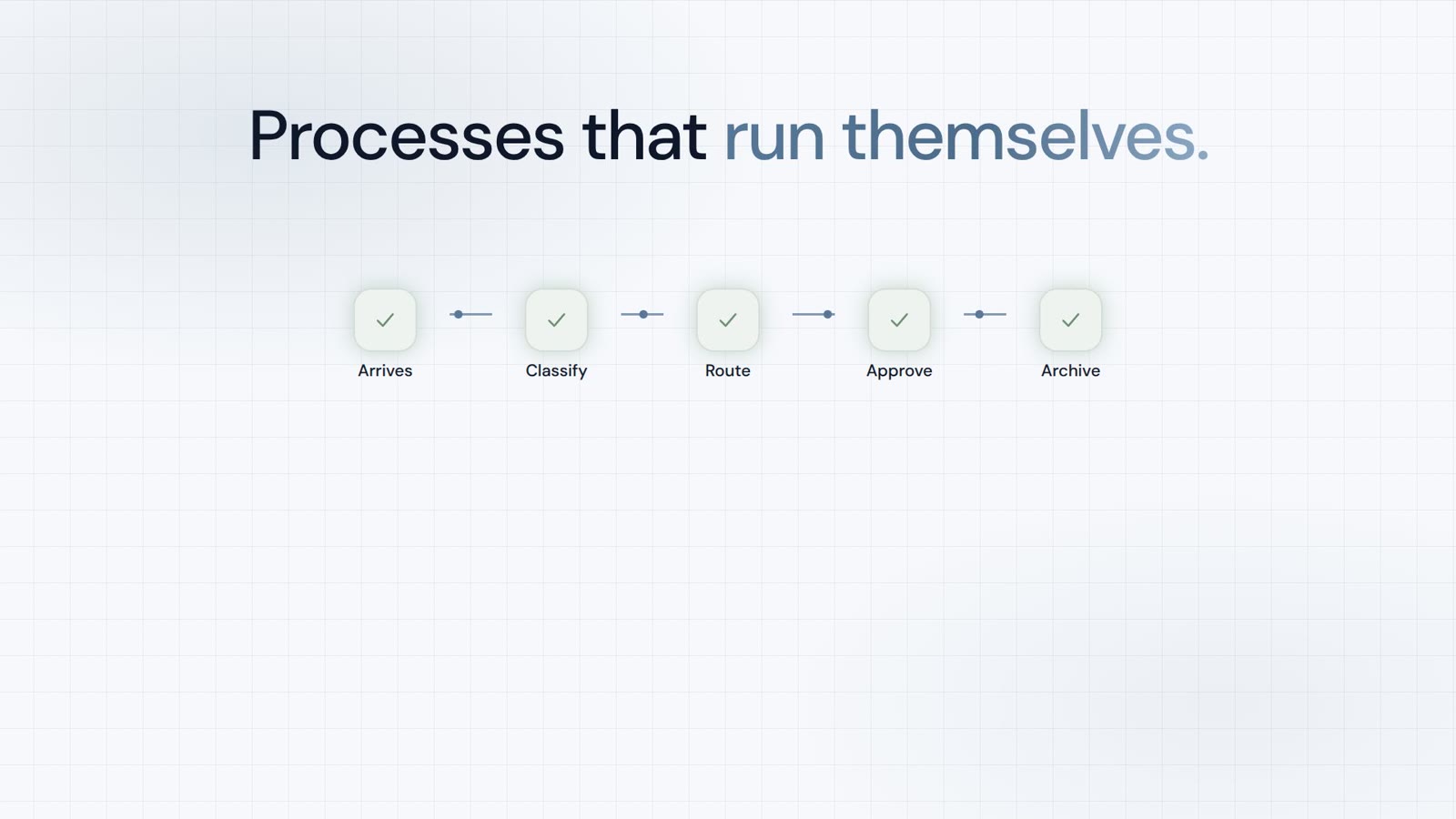
Documents arrive through any channel, are processed automatically per workspace and are ready right away: in the app, on mobile, via API and in your AI assistant.
Upload, including saved emails, scan with the mobile app, email mailbox via IMAP, scanner inbox over SFTP, storage mount on your NAS or server, connector or API. Every workspace has its channels and its processing depth.
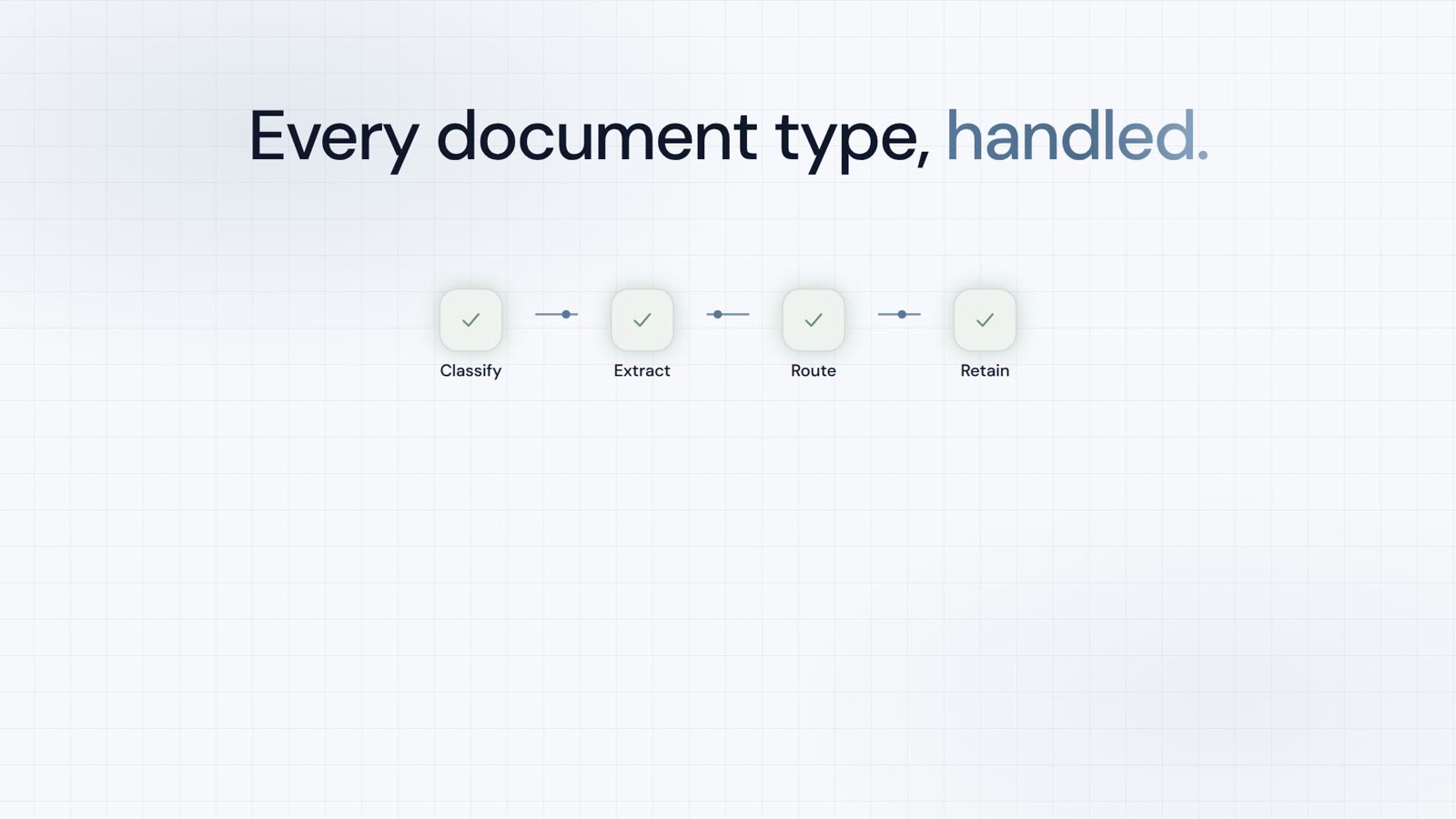
AI-OCR reads the text, classification detects the document type, IDP pulls fields such as sender, amount and due date. Depending on the processing depth, embeddings, document verification and the knowledge graph are added.
Semantic search, document chat, signature, approvals, workflows and versions with an audit trail. The same document in the web app, the mobile app, via REST API and in your AI assistant over MCP.
Everything on board
Capture, understand, sign, redact, verify, route, find: every capability is part of the same platform, with the same permissions and the same audit trail.
Over 120 languages, text layer with bounding boxes, document type, language and folder suggestion automatically on arrival.
Fields, parties, line items and financial data as structured JSON. Agents per document type, no fixed templates.
Sign under eIDAS (SES), in person on a mobile device or by sending to signers, with signature status and evidence.
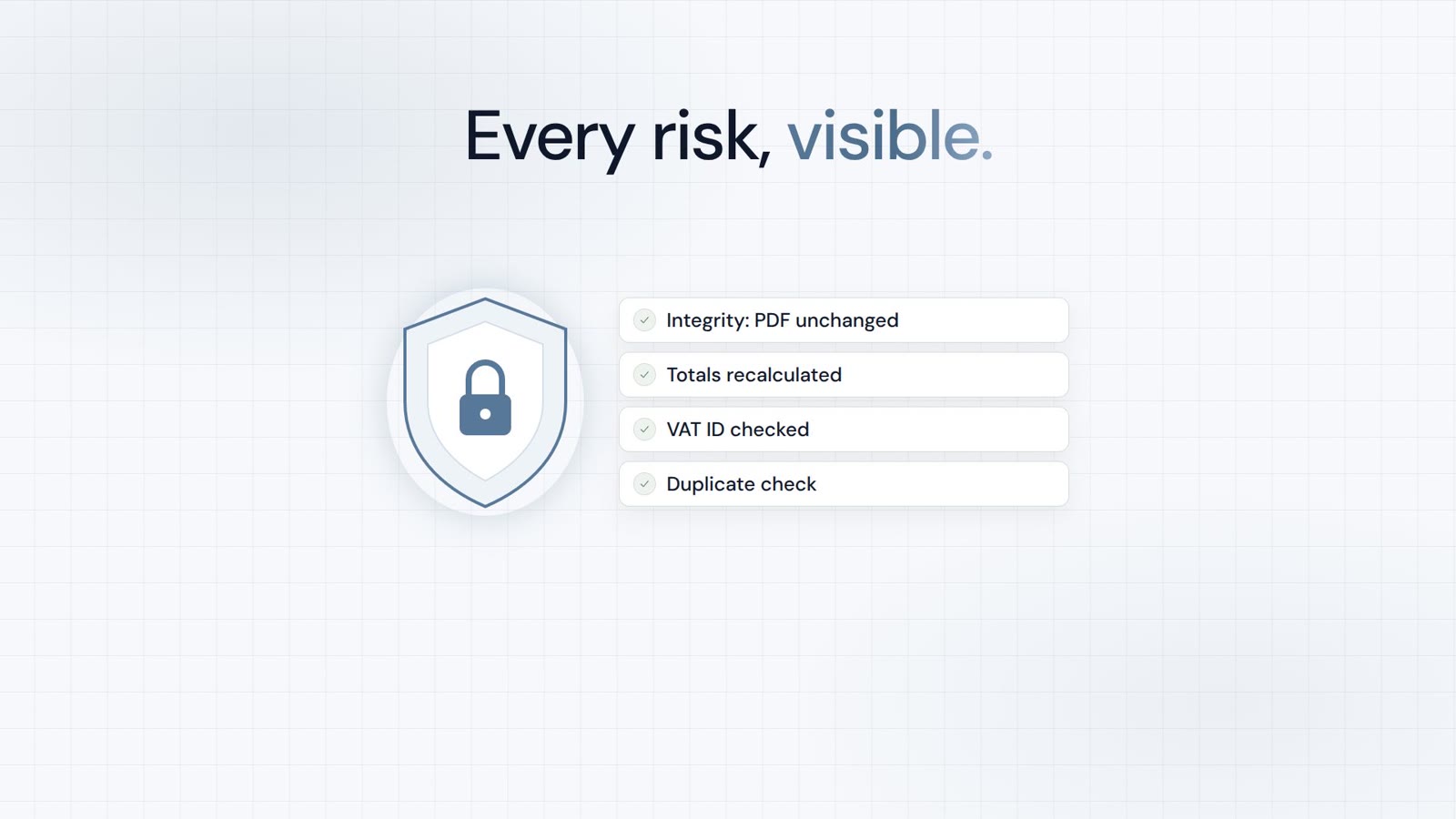
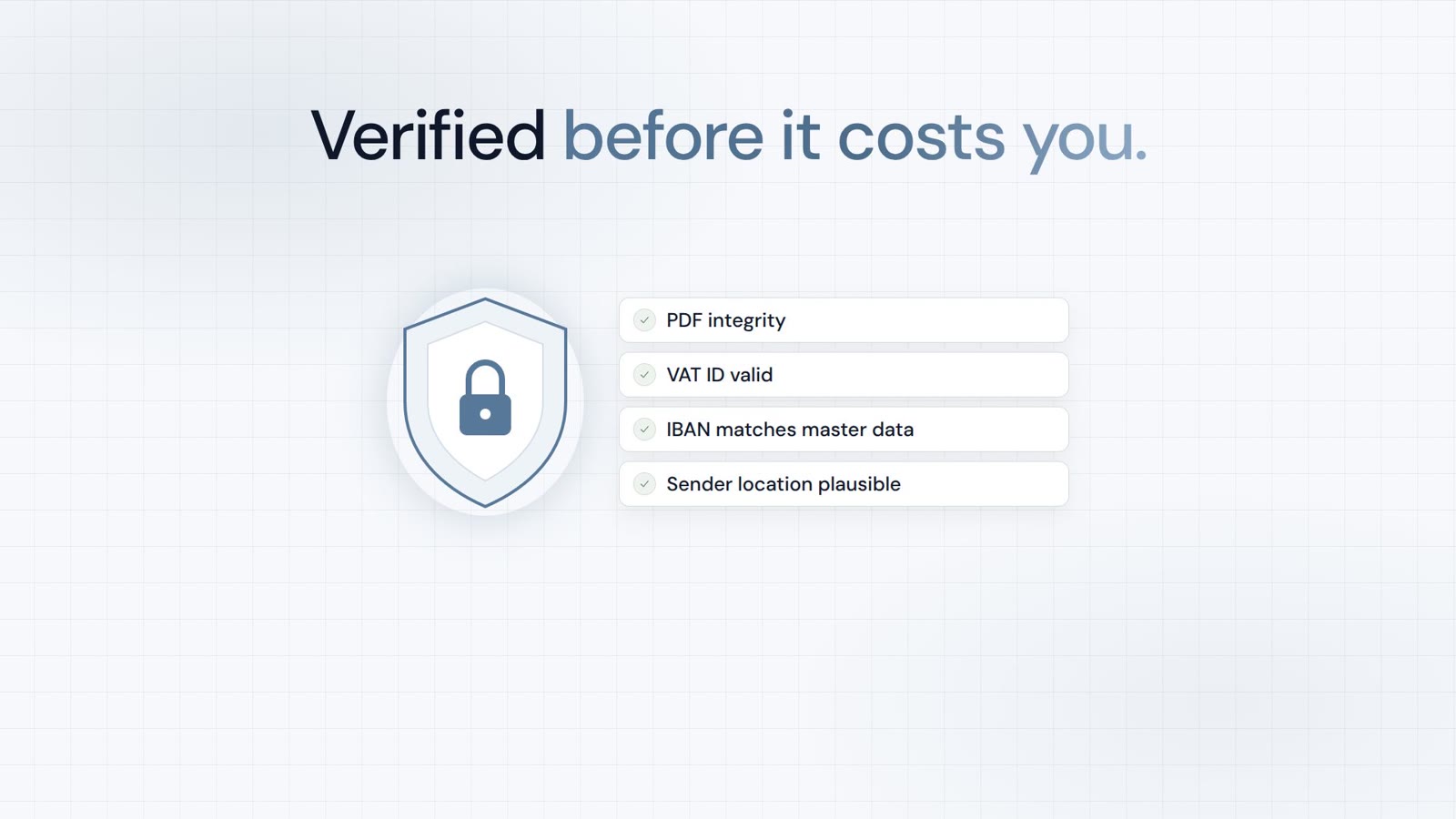
The Redact Agent anonymizes personal data, the Trust Agent detects arithmetic, date and bank anomalies.
Rule-based and AI-driven workflows, human-in-the-loop tasks, approvals and versions with a field-level audit trail.
Embeddings, document chat with source references and a knowledge graph across documents, companies and people.
PWA without an app store: scanner with edge detection, offline queue, document chat and signature.
Files stay on your NAS, server or cloud storage via SFTP, WebDAV or S3. PaperOffice keeps metadata, index and AI results.
Workspaces
You set both per workspace, independently of each other.
Every workspace defines how deep the AI works: store only, read and organize, understand and connect, or verify and link. All levels are part of the platform.
Store only
For legacy archives and drafts
Read and organize
For digital documents with quick filing
Understand and connect
For accounting and contract management
Verify and link
For compliance and deep analysis
The depth applies automatically to every new document in the workspace. Individual documents can be reprocessed later at a higher level.
Every workspace is its own security space with roles, access lists and an audit trail. The type defines how strict the protection is, independent of the processing depth.
For everyday operations
For teams, projects and daily work
For sensitive records
For accounting, HR and contracts
For high security
For regulated industries and audits
Workspace type and processing depth are independent: a Compliance workspace can store only, a Standard workspace can work with Ultra.
Modules
Four stages of the document lifecycle. Every module is part of the platform and available in the app, via API and over MCP.
Comparison
The difference is not the filing, it is what the system does with the document.
| Comparison | Classic DMS | Cloud DMS | PaperOffice AI-DMS |
|---|---|---|---|
| Text recognition | OCR as an add-on | Basic OCR | AI-OCR with bounding boxes |
| Data extraction | Manual tagging | Fixed templates | IDP by prompt, up to Ultra |
| Search | File name and full text | Full text | Semantic with embeddings and chat |
| E-signature | Third-party tool | Add-on module | eIDAS signature included |
| Redaction | Manual | Not available | Redact Agent, AI-assisted |
| Document verification | None | None | Trust Agent with fraud indicators |
| Mobile | Desktop client | Browser | PWA with scanner, offline, signature |
| Storage location | Own server, own maintenance | At the vendor | EU cloud or your own storage |
| AI assistants | Not available | Export required | MCP native: Claude, ChatGPT, Cursor |
curl -X POST \ "https://api.paperoffice.ai/latest/documents/document-put" \ -H "Authorization: Bearer po_ut_YOUR_API_KEY" \ -F "UploadFiles[]=@./invoice_0917.pdf" \ -F "workspace_id=1553" \ -F "processing_mode=ai_dms" \ -F "ai_dms_tier=premium"curl -X POST \ "https://api.paperoffice.ai/latest/documents/document-process/YOUR_POFID" \ -H "Authorization: Bearer po_ut_YOUR_API_KEY" \ -F "ai_dms_tier=ultra"curl -X POST \ "https://api.paperoffice.ai/latest/documents/documents-list" \ -H "Authorization: Bearer po_ut_YOUR_API_KEY" \ --data-urlencode "workspace_id=1553" \ --data-urlencode "global_search=Nordlicht Energie 2026" \ --data-urlencode "search_mode=semantic" \ --data-urlencode "limit=20"{ "mcpServers": { "paperoffice": { "url": "https://mcp.paperoffice.ai/dms", "headers": { "Authorization": "Bearer po_ut_YOUR_USER_TOKEN" } } }}For developers
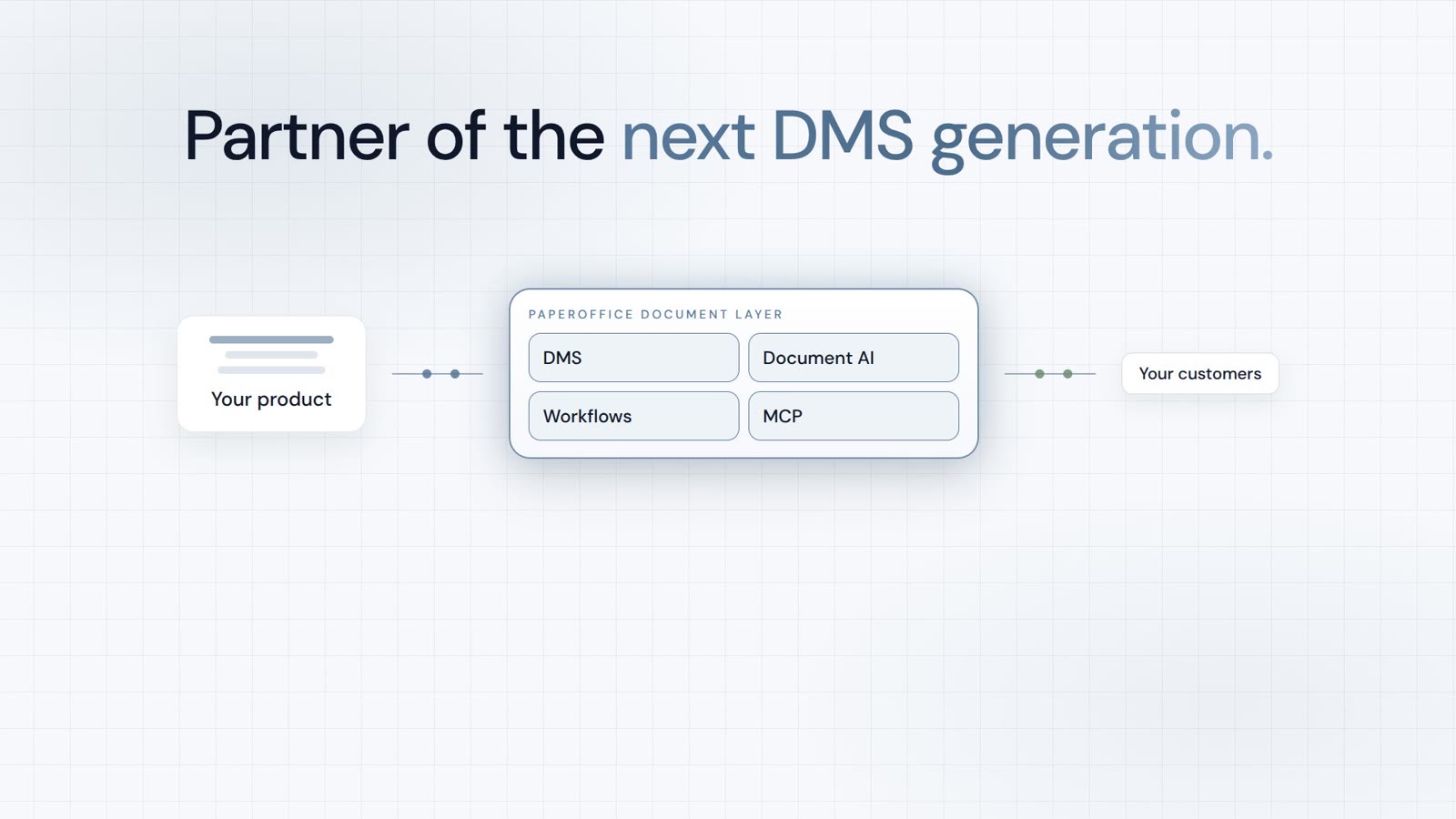
The same platform behind the app is available as a REST API: upload, process, search, version, with webhooks and MCP.
One call stores the document in the workspace and starts the chosen depth.
Events such as processed, checked or approved reach your system immediately.
Over 300 tools for Claude, ChatGPT and Cursor, with OAuth 2.1 or a user token.
Security and compliance
Documents are processed and stored in our own EU data center, encrypted at rest and in transit. Workspace permissions, audit trail and WORM protection apply equally in app, API and MCP.
Case Studies
Discover how businesses transformed their processes with PaperOffice AI.
 Mining & Resources
Enterprise document management for all our mining operations. World class.
 Printing & Packaging
FDA-regulated pharmaceutical labels require complete documentation. PaperOffice has reduced our approval process from days to hours.
 Industry & Manufacturing
Technical documentation and order processing now run fully automatically.
 Public Administration
Digitization has revolutionized our administration. Citizen inquiries are now processed in minutes instead of days.
Health & Medicine Patient records, medical reports, and referrals are automatically captured and classified. Our practice team finally has time for their patients.
 Hospitality & Entertainment
8,000 employees and thousands of guest documents every day. PaperOffice has completely digitized our back-office processes.
 Regional Bank
Loan applications and compliance documents are now processed in minutes instead of hours. The regulatory review is fully automated.
 Construction & Real Estate
Construction project documentation and compliance are now digital and traceable.
 Hospitality & Tourism
Check-in forms, invoices, and guest communications are fully digital. Our concierge team now focuses on providing excellent service.
Energy & Gas Stations Gas station billing, supplier documents, and compliance records from over 250 stations are automatically processed and archived.
Pharma & Labels GMP-relevant documentation for pharmaceutical functional labels now runs automatically. Audit trails are complete and instantly accessible.
Construction & Timber Blueprints, permits, and customer files for our wooden houses are now managed centrally. After six generations, we are finally paperless.
E-Commerce & Retail Supplier contracts, certificates, and customs papers for hundreds of roasteries worldwide are automatically captured and assigned to the correct product.
Logistics & Transport Temperature logs, CMR waybills, and food certificates are automatically scanned and assigned to the order. Misallocations are a thing of the past.
Logistics & Transport Heavy transport permits, route plans, and project documentation are now instantly accessible digitally. No more searching through folders.
 Logistics & Transport
Customs documents, warehouse receipts, and shipping orders for our Eastern European network are automatically classified. Four generations of logistics, finally digital.
Printing & Packaging Printing specifications, customer approvals, and material certificates are now accessible centrally. The production error rate has dropped to near zero.
 Packaging & Labels
Sustainability certificates, supplier contracts, and customer specifications are processed automatically. Swiss precision, now also digital.
 Construction & Real Estate
Building permits, subcontractor contracts, and acceptance protocols for our commercial properties are now fully documented digitally.
Real Estate & Management Purchase agreements, exposés, and customer files from over 30 years of market leadership are now digitally searchable. Every agent finds everything in seconds.
Logistics & Freight Ocean freight documents, customs declarations, and bills of lading are automatically captured. Baltic Sea logistics has never been so efficient.
 E-Commerce & Packaging
Thousands of custom packaging orders per week, including design approvals, print data, and delivery documents. PaperOffice keeps it all together.
 Laboratory & Medical Technology
Pathology lab documentation and device certifications are now fully automated. Complete traceability for every specimen.
Regional Bank Loan documents, security papers, and customer correspondence are processed in minutes instead of hours. The regulatory review is complete.
Steel Construction & Industry Technical specifications, quality certificates, and recycling protocols for our steel production are central and instantly accessible.
 Pharma & Labels
Pharma and cosmetic label specifications with regulatory requirements are automatically checked and approved. No more manual checklists.
 Fintech & Wealth Management
KYC documents, investment reports, and regulatory filings are classified in seconds. As an MAS-regulated robo-advisor, complete compliance is essential.
Logistics & Transport Safety data sheets, transport permits, and ADR documents for chemical logistics are automatically assigned. Zero tolerance for errors.
 Luxury & Jewelry
Certificates of authenticity, supplier records, and customer warranties for our pearl collections are automatically archived and instantly accessible.
 Commercial Bank
SME loan applications, security documents, and regulatory reports are automatically classified. Our advisors have more time for customer consulting.
 Private Bank
Customer files from over 135 years of banking history are being successively digitized. 5,000 employees now have instant access to all documents.
 Development Bank
Microcredit applications and compliance documents for millions of customers are now processed in minutes instead of days. A game changer for financial inclusion.
 E-Commerce Logistics
Hundreds of thousands of delivery notes and return slips per day are processed automatically. Vietnam's leading e-commerce logistics provider, now paperless.
 Precision Metal & Manufacturing
CNC manufacturing protocols, material certificates, and customer specifications for oil, gas, and aerospace projects are now fully documented digitally.
 GovTech & IT
Vision 2030 requires complete digitization. PaperOffice processes government documents for Saudi Arabia's digital backbone.
 Specialty Steel & Industry
Material certificates, hardening protocols, and customer specifications are automatically assigned to the correct order. Australia's only Q&T manufacturer, now paperless.
 Steel Construction & Manufacturing
Weld seam protocols, structural calculations, and project plans are managed digitally. Our workshop teams have access in real time.
 Precision Parts & Manufacturing
Aerospace certificates, CNC programs, and customer tolerances are automatically classified. AS9100 evidence has never been this easy to produce.
 Fintech & Payments
Merchant contracts, KYC documents, and transaction receipts for hundreds of thousands of SMEs are processed in seconds. Mexico's payment revolution, paperless.
 Premium Winery
Harvest documentation, export certificates, and quality protocols for our high-altitude Malbecs are automatically archived. 120 years of winemaking tradition, now digital.
Digital Banking Millions of user verifications and regulatory documents are processed fully automatically. Scaling without paper.
 Fintech & Payments
Merchant onboarding documents and compliance records for Africa's leading payment provider are processed in minutes instead of days.
E-Commerce & Organic Organic certificates, supplier audits, and product labels for thousands of natural products are automatically checked and archived.
 Fintech & Payments
Regulatory documents from 33 African countries, partner contracts, and audit trails are managed fully automatically. An enterprise DMS for a $3 billion fintech.
 Pharma & Healthcare
Prescriptions and medication management now run fully automatically. More time for our patients.
Religious Institution Centuries-old documents are now digitally searchable. A milestone for our historical archives.
Care & Health Our caregivers finally have more time for residents instead of paperwork.
Government & Administration 500,000+ records digitized. Our deputies now find all information instantly.
Medicine & Healthcare Patient records management is now a breeze. Everything automatically captured and archived.
 Estate Services
Inheritance and estate documentation is now efficient and error-free.
Real Estate & Management Digital property management for all our residential complexes. Tenants and owners are thrilled.
Industry & Packaging With PaperOffice, we have accelerated our invoice processing by 99%. The AI automatically recognizes all relevant data and assigns it correctly.
Trades & Crafts PaperOffice has become indispensable to our daily work. Orders, quotes, and invoices are now automated.
Care & Health The documentation of our care services is now digital and automated. More time for our patients.
Mechanical Engineering & Manufacturing Technical drawings, bills of materials, and quality protocols are instantly searchable. A search that used to take 30 minutes now takes 30 seconds.
Tax Advisory & Legal Client receipts, tax assessments, and annual financial statements are automatically sorted and assigned to the correct client. Receipt chaos is a thing of the past.
IT & Consulting Project documentation, SLAs, and customer communication for our IT consulting projects are automatically classified and archived.
Practical guide
In PaperOffice, a workspace is the unit that decides where files are stored, how strictly they are protected and how deeply the AI reads them. You make the core choices when you create the workspace, and every new document follows them. Some of these settings can be changed later and others cannot, as described below. This guide walks through creating a workspace, the first upload, how an automated invoice check behaves, the API calls behind it, and the limits you should know before you rely on it.
The Academy lesson on creating workspaces compares a workspace to a dedicated filing cabinet, for example one per company, project or client. Three settings in it are easy to underestimate because some of them cannot be undone.
The storage location is either the PaperOffice EU data center or your own storage (BYOS, Bring Your Own Storage), which you set up beforehand under Connectors. The lesson states that the storage location cannot be changed after creation. The workspace type (Standard, Business or Compliance) sets protection and evidence. You can upgrade a type at any time but not downgrade it. The AI-DMS tier sets how thoroughly documents are read, and it is separate from the type.
The steps follow the Academy lessons on creating a workspace and uploading documents. The demo company in the lessons is called Northstar Industrial.
The lessons describe the tiers in a few plain sentences. Storage only keeps files without automatic processing, and you can process them later. Basic makes the archive searchable with text recognition, classification and keywords. Premium also reads business fields, detects relationships between documents and reports duplicates. Ultra reads tables, forms and barcodes, adds the Knowledge Graph and cross-document reasoning, and runs an audit with twelve controls that places suspicious documents in quarantine.
In the page film, the AI-DMS switch sits in the workspace settings, and a badge marks the tier that new workspaces start with. Every new document runs through the chosen tier automatically, and any document can be sent deeper later. The app asks for confirmation before it reprocesses a document. The AI-DMS tiers are paid functions.
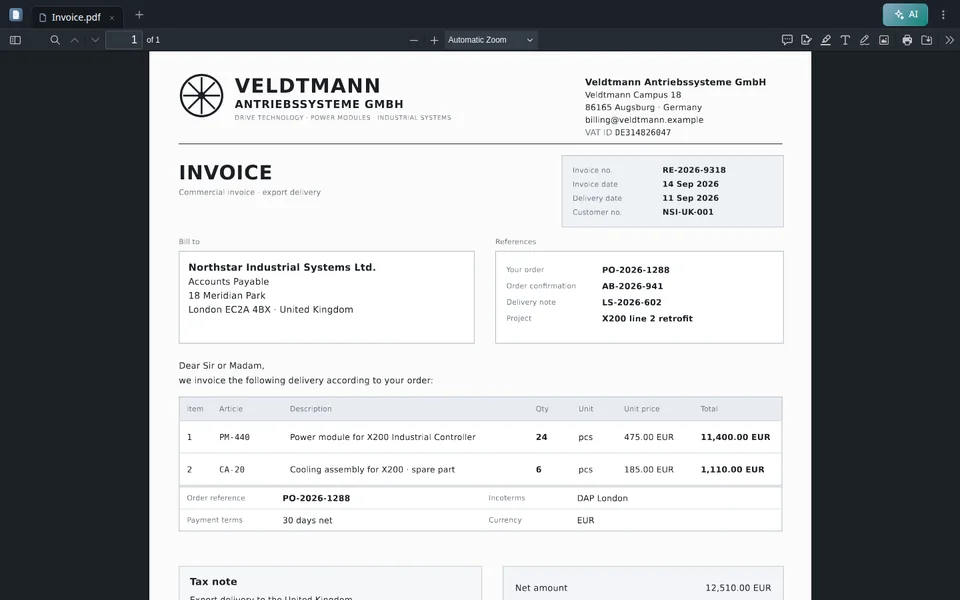
The film uses fictional documents. An invoice, RE-2026-7834 from Veldtmann Antriebssysteme GmbH, arrives in a workspace. AI-OCR and classification identify the document type. An IDP Agent then fetches the fields you defined, each with its page and position in the original. Another layout or language still works, because the agent reads meaning rather than coordinates. If a required field is missing, the document goes to your review queue.
Next, you describe in Prompt Studio under Workflow Agents what should happen. The film uses this text: if an invoice matches its order, mark it approved, and if not, send it to finance with the reason. The start event is After AI-DMS has completed, filtered to the document type Invoice. In the film, the agent reads the invoice, searches for the order PO-2026-1042, compares both and marks the invoice as approved. A Tool timeline lists each step with the tool used, for example po_documents_search and po_documents_edit.
Because the agent changes a document field, a signed webhook of type document.edited is sent to the ERP system in the example. The ERP is notified, and PaperOffice does not book anything there. The film's own notes say the order comparison by a Workflow Agent was not tested live, so treat it as an illustration and test your own prompt.
A Workflow Agent does not start on its own after you write a prompt. The app shows that automation stays locked until the prompt is approved and tested, and the film repeats this. In the Academy lesson on workflow approvals, two Veldtmann invoices arrive. The agent marks the small one as reviewed. For the large one, it pauses, and the Automation column shows an hourglass next to Workflow.
The approval then waits as a task under Human In The Loop Tasks, with supplier, invoice number and amount. A person can decide it with a short comment or forward it to someone else, such as management. After the decision, the agent continues. Storage can also stay under your control: with BYOS over SFTP, new documents are written to your device, encrypted with your own password, while PaperOffice keeps the index, the metadata and the AI results.
Everything above can be driven without the app. POST /documents/document-put uploads a file as multipart data or fetches it from an HTTPS source_url. You pass workspace_id, or workspace_name, which creates the workspace if the name is new. The response contains results[] with one pofid per file, not a top-level pofid. With ai_dms_tier set to basic, premium or ultra, you request a tier for that upload. If the AI-DMS order is refused, the file is still stored and the result carries ai_dms_billing.
A new workspace is created with the Premium tier active when you omit ai_dms_mode. Allowed values are disabled, basic, premium and ultra, and changing the mode later may reprocess existing documents. A new version of a document is uploaded with version_of_pofid. The source needs an AI-DMS tier, otherwise the API returns VERSIONING_REQUIRES_AI_DMS, and a lower tier than the predecessor returns VERSION_TIER_DOWNGRADE.
For events, POST /webhooks/subscribe takes events such as document.uploaded and document.edited. Every delivery carries X-PaperOffice-Signature: sha256=<hex>, the HMAC-SHA256 of the raw body, and receivers must verify it. For AI assistants, MCP tools such as po_documents_search, po_documents_get and po_knowledge_graph_references_get give access to a workspace with your permissions.
Connect document processing to your workflows and AI assistants. Choose the guide for your next step.
Use HTTP Request, Webhook and MCP Client nodes to connect your document workflows.
See how documents are classified, extracted and checked before the next workflow step.
Connect an AI assistant to PaperOffice document tools and review the available capabilities.
Frequently asked questions
PaperOffice. PaperOffice is the DMS for companies and SMEs: capture, understand and work in one platform, in the EU.
A complete document management system where AI processing is part of filing: AI-OCR, classification, data extraction, embeddings for semantic search, document verification and a knowledge graph. Plus e-signature, redaction, workflows, approvals, versions with audit trail, mobile app, REST API and MCP for AI assistants.
No. OCR, IDP, e-signature, redaction, document verification, workflows, search, chat and the mobile app are part of the same platform. Every capability works with the same workspace permissions and the same audit trail, in the app, via API and over MCP.
You define per workspace how deep the AI works. Archive only stores, Basic reads and organizes, Premium extracts extended fields and builds embeddings, Ultra verifies the document and links it in the knowledge graph. Individual documents can be reprocessed later at a higher level.
Yes, if you want them to. Storage mounts connect NAS, servers or cloud storage via SFTP, WebDAV or S3. The files stay there, PaperOffice stores metadata, index and AI results. Alternatively you use PaperOffice EU cloud storage.
Standard brings AES-256 chunk encryption of every file, access lists, versions and permanent deletion. Business adds a recycle bin, WORM write protection, a workspace password and SMS or two-person approval. Compliance works with hardware encryption, IP whitelist and mandatory 2FA for high-security requirements. The type is independent of the processing depth.
Yes. The MCP server exposes the complete tool catalog: search, extract, sign, start workflows. Permissions and audit trail apply in the assistant exactly as in the web app, processing stays in the EU.
Yes, every function is available headless via REST: upload, process, search, sign, version, start workflows. Plus webhooks for events and the MCP server with over 300 tools. API and app work on the same documents with the same permissions.
Free, with no credit card: create a workspace, choose the processing depth, upload documents. Existing archives come in as ZIP, via storage mount or from an ELO export, and the mobile app scans paper straight into the workspace.
On the central pricing page. It lists all plans, inclusive services and options. This page describes the feature scope of the AI-DMS.
Where would you like to try PaperOffice?
Your trial is ready
Where would you like to start?
The full workspace is optimized for the computer. The mobile version is for capturing, reviewing, and approving documents.
Register free Already a customer? Log in app.paperoffice.aiStart on the computer
A personal access link will be sent to the email address provided.
Open PaperOffice Mobile
Capture and work with documents directly on the smartphone.
Open mobile version
Integrator and Reseller can be combined. Referral by invitation.
View the partner program
AI-DMS
Documents. Intelligence. Real impact.
PaperOffice AI is the AI-DMS. Four functional areas on one DMS foundation, with three ways in.
Features, modules and benefits at a glance.
Capture, organize, search and collaborate on documents.
Plug into your systems and AI workflows.
No installation, ready in seconds.
Search all tools