The first computer
Daniel Schönland from Gütersloh receives his first computer: a TI-99/4A, plus Extended BASIC for his birthday. He programmes before he learns to write at primary school. The C64, Amiga 500 and Amiga 600 follow.



About PaperOffice
From a challenge of his own to intelligent document processing. The story of Daniel Schönland and PaperOffice.

The founder
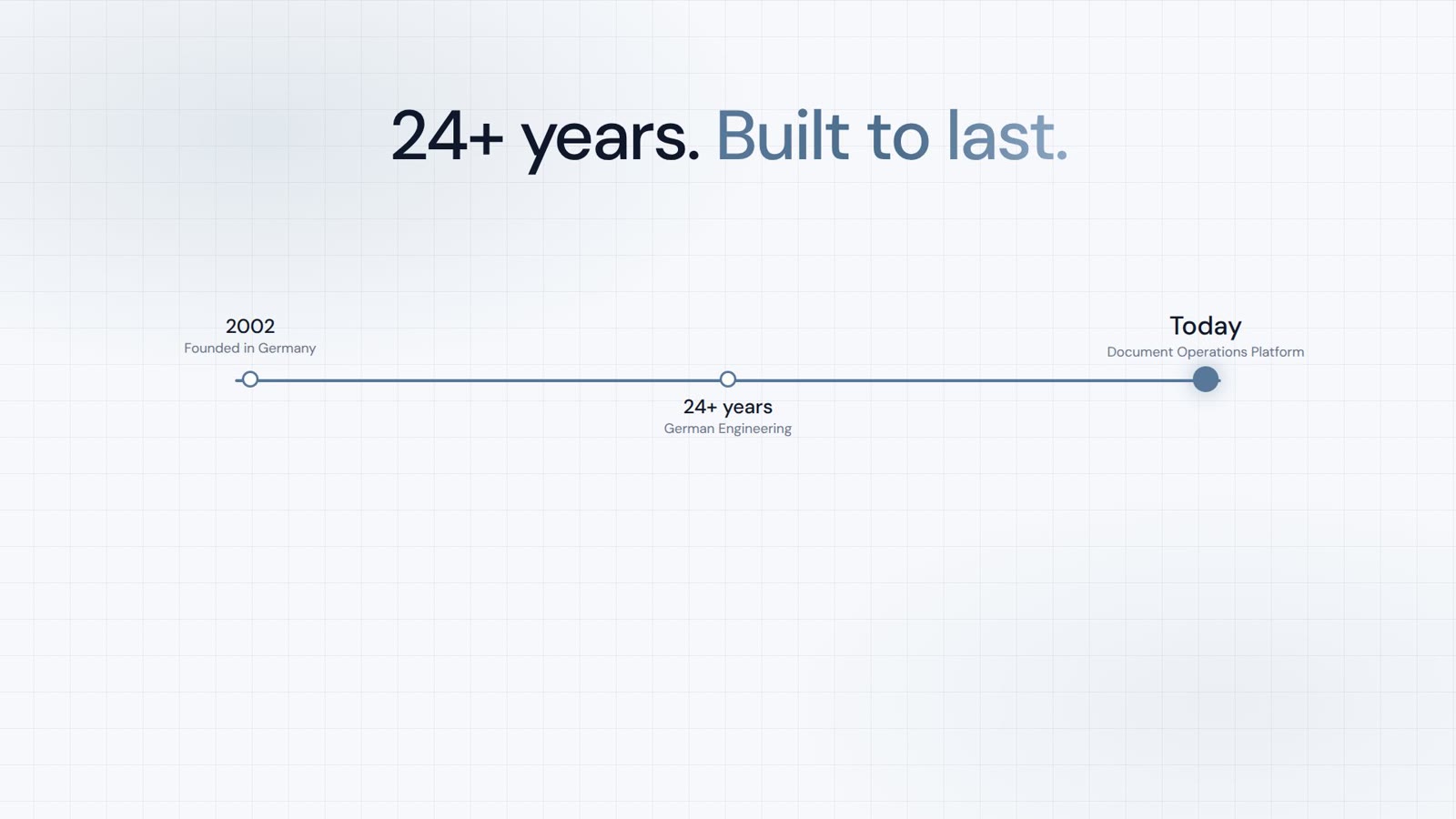
In 2002 Daniel Schönland is looking for software to deal with document chaos in his own company. What is available does not fit his requirements. So he builds it himself.
The internal solution becomes PaperOffice. What starts as a concrete task grows over the years into a platform for intelligent document processing.
The story connects technical curiosity with a question that remains: how can work with documents be made better?
Our development
The founder’s beginnings. The development of PaperOffice. From 1983 to today.
Daniel Schönland from Gütersloh receives his first computer: a TI-99/4A, plus Extended BASIC for his birthday. He programmes before he learns to write at primary school. The C64, Amiga 500 and Amiga 600 follow.
First own server running SuSE Linux. First websites in plain HTML, long before CSS. In 1996 PHP and MySQL are added, the tools that later power PaperOffice.
Professional work at Lycos in Gütersloh and at Schlund+Partner (today 1&1 / United Internet): data centre, frontend, backend. In parallel communication design at FH Bielefeld and IT systems management at the IHK.
The beginning
Daniel Schönland builds the first version of PaperOffice because no software on the market fits his own company.
A move to MySQL as the basis for revision-safe filing. COMPUTERBILD presents PaperOffice.
PaperOffice is on the cover of ComputerBild, with a magazine DVD in Germany, Poland and Russia. The same year, work begins on machine learning for document classification.
The application is rebuilt from the ground up. First deep-learning models go into use for OCR and classification.

QNAP selects PaperOffice as exclusive worldwide DMS partner. The collaboration connects document management with the storage infrastructure companies already use — and strengthens the international use of PaperOffice.
Distributed work becomes everyday practice for many companies. PaperOffice expands support for collaboration across sites. Teams should be able to access their documents together while keeping control of their data.
Late in 2022 we begin integrating ChatGPT into PaperOffice. This extends our previous work with machine learning to generative AI. The focus is how language and document content can be used in everyday work with information.
We begin specializing large language models through targeted fine-tuning for the needs of document processing. At the same time, existing machine-learning engines are gradually moved to LLM-based processing pipelines. AI becomes a fixed part of the PaperOffice architecture — from classification through to structured processing of content.

We begin running our AI models on our own GPU clusters. This gives us more control over compute, model operations and the technical development of our AI.
In the same year, ASUSTOR, a subsidiary of ASUS, selects PaperOffice as exclusive DMS partner. A further international partnership connects our software with established storage technology.
The PaperOffice DataCenter in Navarra, Spain, goes into operation. Here we bring together our own hardware and the operation of our central AI processing. The core pipeline runs on our infrastructure in the European Union, without requiring US public-cloud services.
The aim is Data in → Data out: data comes in, is processed here, results go out — nowhere else.
Today
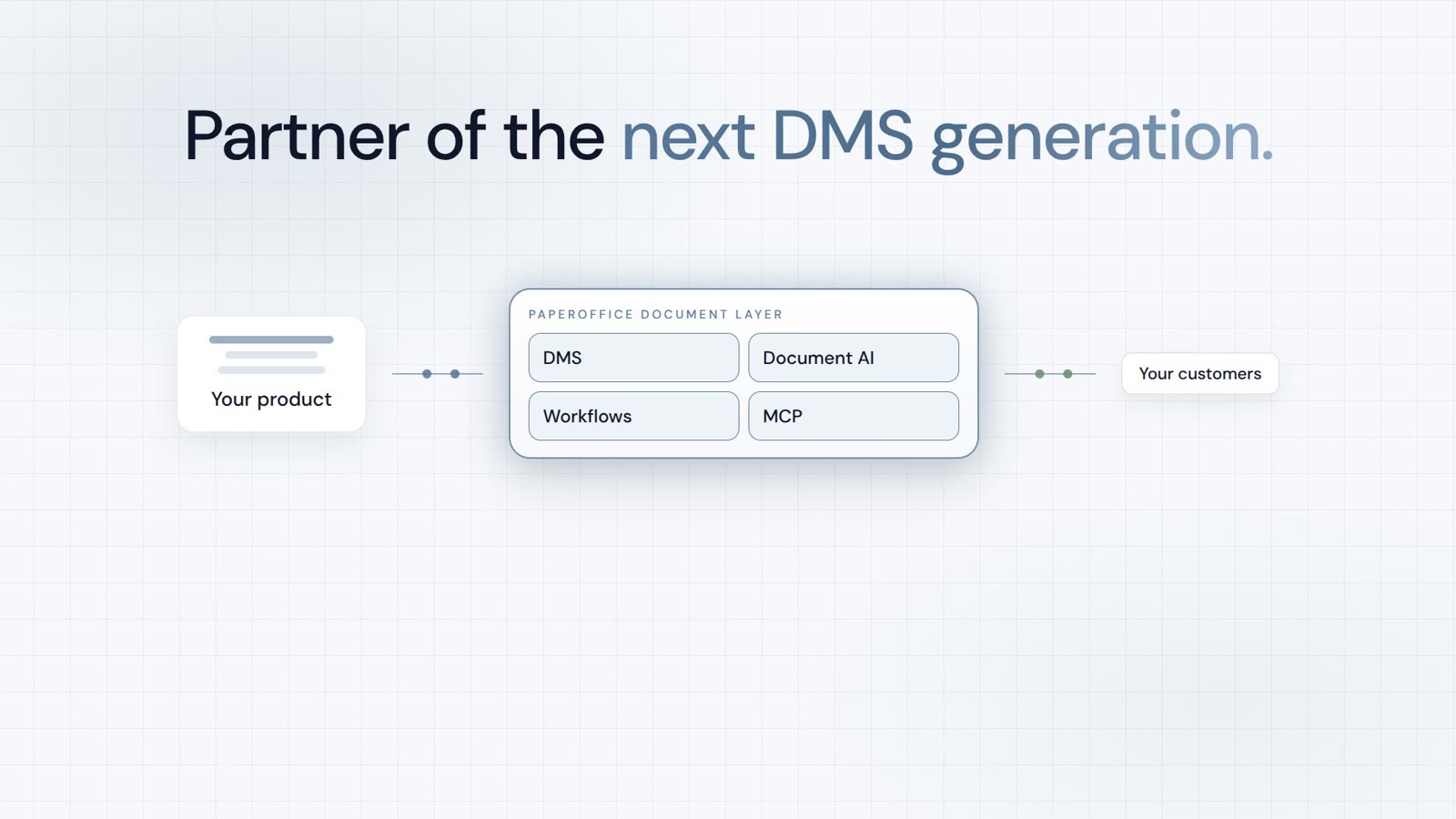
PaperOffice connects document management, specialised AI and automated processes into a platform for AI Document Operations. Organisations use it directly in the app, via API in their own applications, or via MCP with their AI agents. Documents are captured, understood, reviewed, processed and connected to business processes.

Developing further together
AI-first. Developed together. Thought long term.
What can be automated is automated. Everyone on the team works with AI support — and brings experience, judgement and responsibility.
How PaperOffice worksOur principles
Decisions with people, data and long-term value in view. Development and operations belong together.
An answer becomes knowledge for everyone. Solutions are documented and made reusable through knowledge bases.
Use experience, question processes and develop what is new. The focus is on what makes customers’ work better.
Learn more
People, ways of working and infrastructure. And the ways to move forward together.
The people who keep developing PaperOffice together.
Meet the teamAI-first, digital, and with knowledge that helps everyone.
Discover how we workOwn hardware. Own operations. In the European Union.
View the infrastructureBuild customer solutions as an integrator or reseller.
Explore the partner programmeFrequently asked
The key answers about PaperOffice.
Daniel Schönland founded PaperOffice in 2002 and leads the company as CEO. Development, operations and support work on the platform together. Meet the team.
The first version of PaperOffice was created in 2002. The founder’s personal history goes back to his first computer in 1983. The timeline shows both developments.
PaperOffice works AI-first: what can be automated is automated. The team uses AI, documents solutions and makes knowledge reusable. Communication is primarily digital; when a request cannot be resolved that way, the team is available in person. More about how we work.
PaperOffice operates its own infrastructure in the European Union. Information on processing, safeguards and evidence is on the pages about the data centre and security and compliance.
The partner programme is for integrators and resellers who want to develop or offer customer solutions with PaperOffice. Explore the partner programme or Start a partnership. For joining the team, open positions are listed.