



Start on the computer
A personal access link will be sent to the email address provided.


Help and answers
Answers on the platform, processing, security, integration and billing — each with a link to the right page.
If a question is missing, support will answer it.
Trusted by leading companies worldwide








OEM PARTNERSHIP
Platform
PaperOffice AI is the Document Operations Platform for the full document lifecycle: capture, understanding, review, approval, automation and archive run on one shared platform — as an app, as a REST API and as an MCP server.
The platform groups capture, understanding, creation and agents: workspaces, AI-OCR, IDP, classification, search, signature, workflow plus chat and phone agents. Modules can be combined freely, and every module page states its task, how it runs and its limits.
Yes. The web app and the mobile app use the same workspaces and the same permissions as API and MCP. A developer project is possible, but not a prerequisite.
With an account in the app: create a workspace, upload documents, choose the processing depth. Existing archives come in as a ZIP, via a storage mount or from an ELO export.
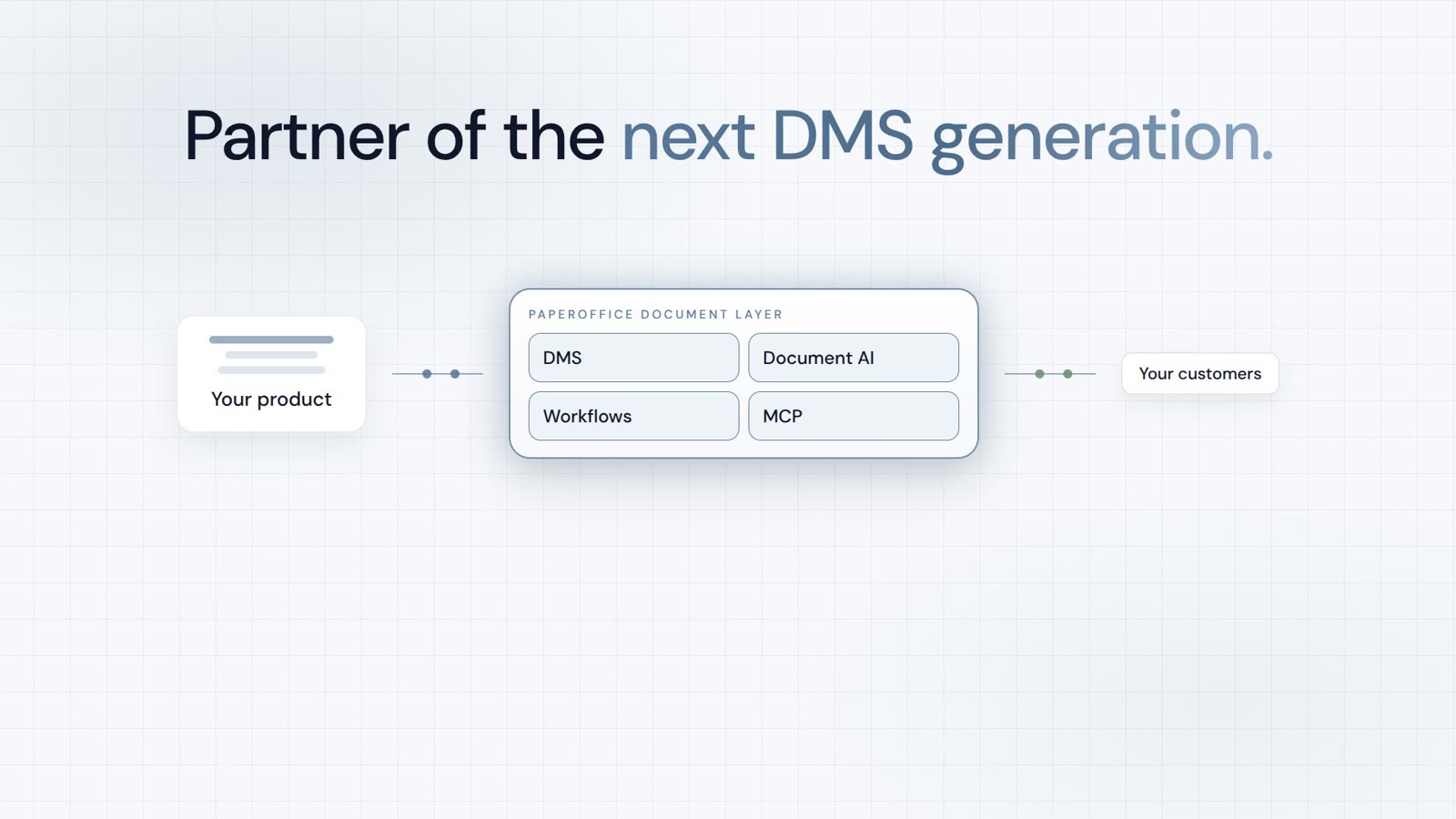
Classic DMS products archive files. PaperOffice joins archive, permissions, Document AI, workflow, signature and MCP in one shared platform — not as a parallel system beside the archive.
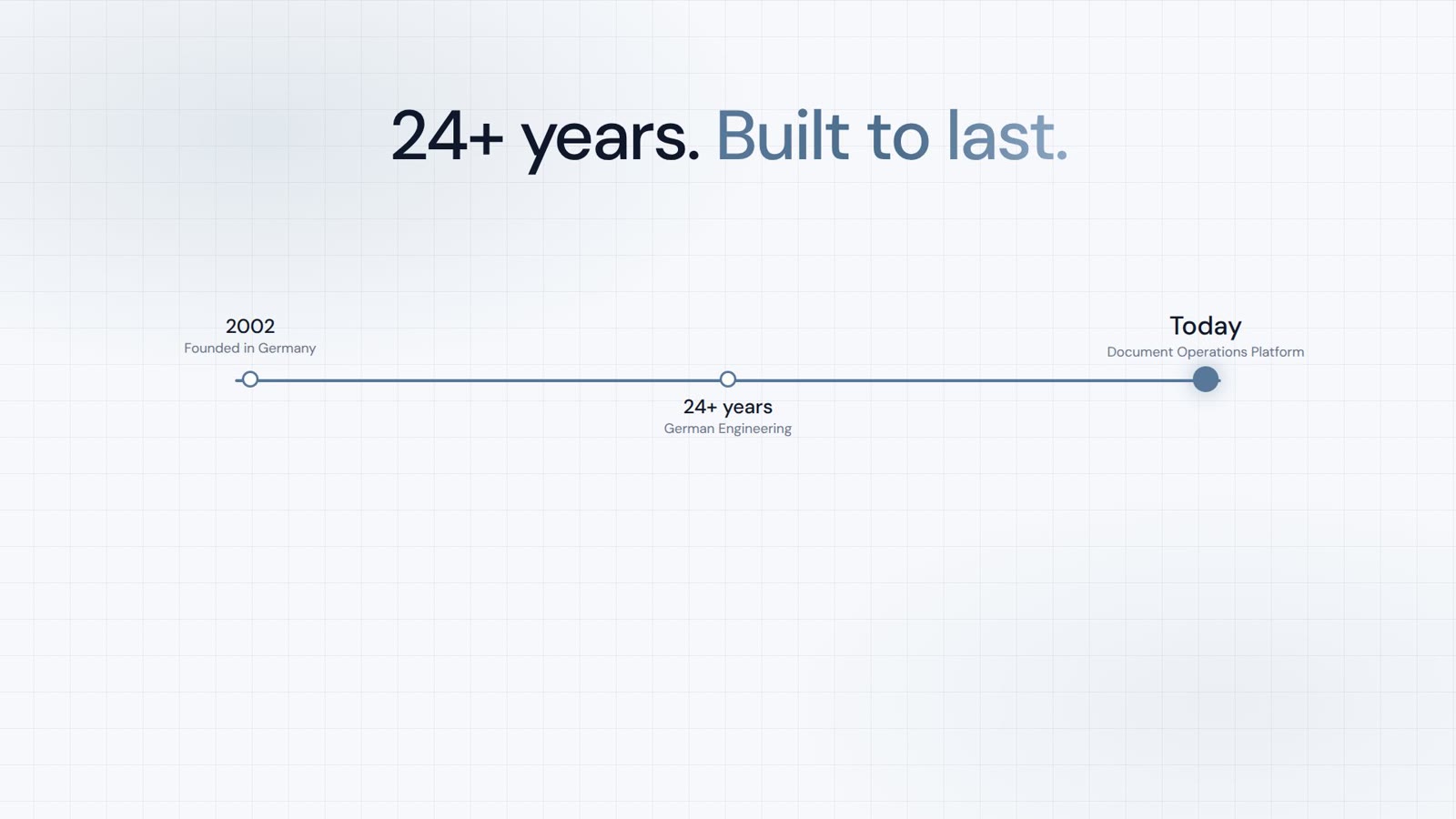
PaperOffice Classic is the on-premises DMS with a Windows client. PaperOffice AI is the Document Operations Platform with app, API, MCP and owned EU infrastructure. Both lines exist in parallel.
Documents
PDF, including multi-page, plus PNG, JPG, TIFF, BMP and WebP. Scans, smartphone photos and screenshots are read just like digitally created files.
No. IDP Agents work zero-shot: you describe the fields you want in natural language. The template catalog with more than 60 document types is a starting point, not a requirement.
Classic OCR recognises characters without context. AI-OCR reads the page in context: layout, tables and handwriting. Every line comes back with a confidence value and a bounding box.
Every field carries a confidence value and a bounding box so you can trace it on the page. Missing required fields and failed extractions go automatically into the human-in-the-loop review.
Yes. In Complete mode, rows and columns are recognised and returned as structure, even across several pages.
The language is detected automatically; optionally you pass a locale hint per call. Pages in mixed languages are possible.
Security
In owned data centers in the EU on owned hardware. There is no dependency on US hyperscalers.
All connections run over TLS 1.3, storage is encrypted with AES-256. Processing runs on RAM disk; the working copy is deleted once the job is finished.
ISO 27001 and SOC 2 Type II are active. Reports are available on request under NDA.
No. There is no training on your data, no external AI providers and no AI subprocessors.
Yes. Storage mounts connect NAS, servers or cloud storage via SFTP, WebDAV or S3. The files stay there; PaperOffice holds metadata, index and results.
Permissions apply per workspace and user — in the app, through the API and in the AI assistant alike. Every access is in the audit trail.
API and MCP
Yes. App, REST API and MCP share the same workspaces, permissions and results. There is no separate product account per surface.
Yes. Via MCP the same document functions are available as tools. You enter the server URL in your tool and sign in with your account.
Only what the key in use is allowed to see. Permissions apply per workspace, and every access is in the audit trail.
Yes. Keys can be blocked at any time, which ends access immediately.
Yes. Results can be delivered by webhook, signed with HMAC-SHA256. Alternatively you poll the job status through the API.
Not for the guides for Claude, ChatGPT, Grok and Cursor. For your own integrations there are the API catalog, the Postman collection and llms.txt.
Billing
Processing is billed, not the connection — the same rates in app, API and MCP. The public price list is on the pricing page.
Yes, a free plan is available for trying things out. Its scope and all other plans are in the plan comparison on the pricing page.
The plan comparison on the pricing page shows it. For every plan it states which access and which support level are included.
Through the support page and the contact form. Which support level belongs to a plan is stated in the plan comparison.
Through the live test in the browser: upload a document, look at the result. After that you continue in your own workspace.
Read on
Every question above has a page that covers the topic in full.
Where would you like to try PaperOffice?
Your trial is ready
Where would you like to start?
The full workspace is optimized for the computer. The mobile version is for capturing, reviewing, and approving documents.
app.paperoffice.aiStart on the computer
A personal access link will be sent to the email address provided.
Open PaperOffice Mobile
Capture and work with documents directly on the smartphone.
Open mobile version