


Scan, Sign & AI Chat
Mobile App
The mobile app pairs with your account via QR code and brings scanner, signature, chat and documents to your phone.
Publishable Keys
A publishable key (po_pk_) may live in frontend code: scope-limited, origin-locked and budget-capped.
For Claude Artifacts, ChatGPT Canvas, Grok and any web app of your own.

Straight from the browser
You build a PDF-to-text app in Claude Artifacts, ChatGPT Canvas or Grok. Without a backend, the API call used to fail: CORS blocked it, a secret key would be visible in the source code, and an open key would burden your account. Publishable keys close exactly this gap.
One prompt that turns any AI canvas into a real, API-backed demo — no backend required.
Read this API doc:
https://api.paperoffice.ai/latest/docs/llms-full.txt Build a single-file React app (Claude Artifact / ChatGPT Canvas / Grok):
User uploads a PDF, the app calls
/job/add/paperoffice_aiocr___generate directly from the browser
and shows the extracted text. Auth: Bearer po_pk_MY_PUBLISHABLE_KEY (prompt user for the key).
Use processing_lane=instant for sync results. Origin header is set by the browser.The dashboard ships presets for scopes and budget. Origins stay empty — paste the Origin header from the browser DevTools, then copy the key into your prompt.
const form = new FormData();form.append("file_1", fileInput.files[0]);form.append("processing_lane", "instant");form.append("client_wait", "true");const response = await fetch("https://api.paperoffice.ai/latest/job/add/paperoffice_aiocr___generate", { method: "POST", headers: { Authorization: "Bearer po_pk_YOUR_PUBLISHABLE_KEY" }, body: form,});console.log(await response.json());curl -X POST "https://api.paperoffice.ai/latest/job/add/paperoffice_aiocr___generate" \ -H "Authorization: Bearer po_pk_YOUR_PUBLISHABLE_KEY" \ -H "Origin: https://app.example.com" \ -F "file_1=@invoice.pdf" \ -F "processing_lane=instant" \ -F "client_wait=true"First call
The call goes to POST /latest/job/add/{pipeline} — the same endpoint as with a secret key. Only the key type and the Origin header, which the browser sends automatically, are new.
fetch sets the Origin header itself. Scripts outside the browser (cURL, Node) must send it explicitly — otherwise the API answers 403 ORIGIN_HEADER_REQUIRED.
With processing_lane=instant and client_wait=true the API holds the connection and returns the result directly in the response.
402 BUDGET_EXHAUSTED, 403 DOMAIN_NOT_ALLOWED, 403 SCOPE_NOT_GRANTED, 429 RATE_LIMIT_EXCEEDED — every limit reports with its own code.
Security matrix
Scope-limited, origin-locked, budget-capped, revocable at any time. Every control is enforced server-side — which is why the key may sit in frontend code.
Keys only reach the endpoint groups you explicitly allow: ocr:read, llm:generate, translate:text and more. Out-of-scope calls return HTTP 403.
Every request must carry an Origin header matching the token allow list (exact host or subdomain wildcard). If it does not match, the API returns HTTP 403.
There is no extra per-minute cap unique to po_pk_. Normal per-token account rate limits apply; spend is capped by the lifetime budget.
Every key carries a lifetime budget. Once it is used up, the API returns HTTP 402 BUDGET_EXHAUSTED — spend stops there, not at invoicing time.
Keys can be revoked in your account at any time. A revoked key is no longer accepted by the API.
HTTP DELETE plus account login, key management, OAuth, partner admin, payment-method mutation and password-cracking stay hard-blocked for every po_pk_. Documented product APIs — including POST deletes, webhooks, billing reads and CRM — are allowed.
Key hierarchy
Secret key for the server, publishable key for the browser — plus a user token for user-scoped, rate-limited access.
| Prefix | Type | Use case | Browser-safe | Default scope |
|---|---|---|---|---|
poai_ | API key | Server-to-server, rights of the creating account | No | All endpoints within plan and permissions |
po_ut_ | User Token | User-scoped, tier-limited | No | Tier-based |
po_pk_ | Publishable Key | Browser / AI canvas (Claude, ChatGPT, Grok) | Yes | Scope list |
Three presets
Each preset is tuned for a concrete use case — safe defaults, curated scopes, realistic budgets. You can fine-tune everything in the dashboard later.
DEFAULT Safe read Safe default rights for simple demos and internal tools: OCR, LLM, Translate, Documents, Search.
Scopes
Start with this presetAIDEMO AI playground Recommended For Claude Artifacts, ChatGPT Canvas and Grok demos. Everything you need to bring AI demos live.
Scopes
Start with this presetWIDGET Public website For contact forms, chat widgets and booking buttons on your own company site.
Scopes
Start with this presetFirst API call
Create a key, open llms-full.txt, paste the prompt — your app calls the API directly from Claude, ChatGPT or Grok.
Frequently asked
poai_ (API key) is for server-to-server integration — it works with the rights of the account that creates it and never belongs in the browser. po_pk_ (Publishable Key) is built for browser code: scope-limited, origin-locked, budget-capped. Same API, different safety profile.
This is the classic approach — but it still requires a backend. AI artifacts (Claude, ChatGPT, Grok) are designed for zero-backend deployment. Publishable keys make this possible without exposing your secret key: limits are enforced server-side.
Yes. The call runs straight from the browser, and the browser sets the Origin header itself. PaperOffice does not ship a vendor allow list; paste the Origin from DevTools when you create the key.
The damage stays contained: the origin lock blocks use on other domains, the budget limit ends spend, the rate limit slows automated access. Revoke the key in your account — after that the API no longer accepts it.
Yes. When creating the key you add any origin to the allow list — as an exact host or a subdomain wildcard. The WIDGET preset is built for exactly this: register your own domain and embed chat, booking or contact widgets without a backend.
When creating the key you pick a lifetime limit; each preset comes with a default. Once the limit is reached, the API returns HTTP 402 BUDGET_EXHAUSTED. You can adjust the value in your account at any time.
No. The publishable key is an extra layer around your existing account: it limits scopes, origins and budget. The pricing overview shows which plan fits your setup.
HTTP DELETE plus account login, user-admin, key management, OAuth, partner admin, Stripe checkout and password-cracking are hard-blocked. Documented product APIs are allowed, including POST deletes, webhooks, billing reads, import and CRM. Workspace delete, empty trash and legal-hold release stay UI-only (403 UI_ONLY_ENDPOINT).
Operations and trust
Contracts, security, support and limits, all linked in one place.
Next station
The recommended next step in the developer funnel and two fitting branches.

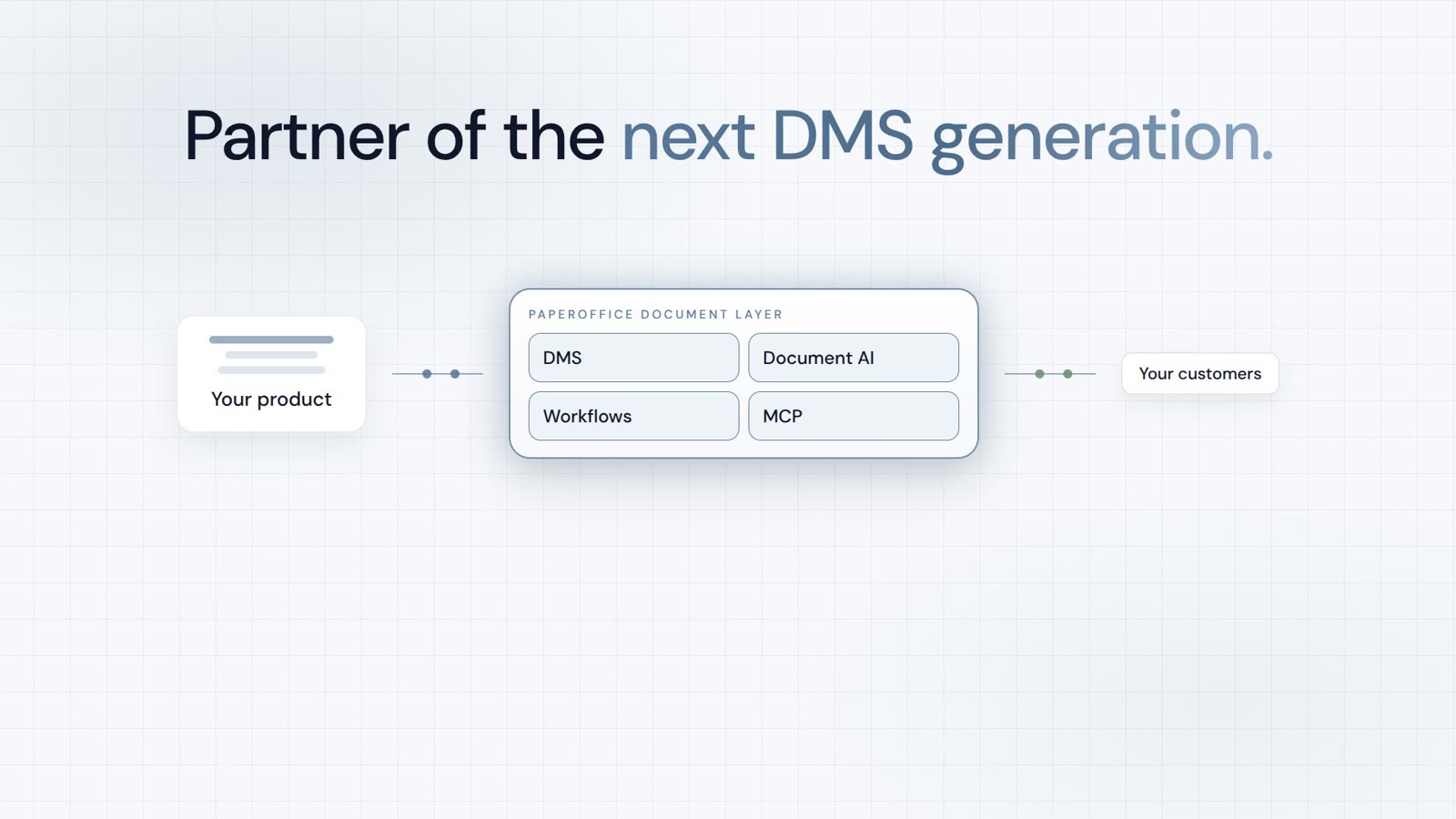
Integrator and Reseller can be combined. Referral by invitation.
View the partner program
AI-DMS
Documents. Intelligence. Real impact.
PaperOffice AI is the AI-DMS. Four functional areas on one DMS foundation, with three ways in.
Features, modules and benefits at a glance.
Capture, organize, search and collaborate on documents.
Plug into your systems and AI workflows.
No installation, ready in seconds.
Search all tools