

Scan, Sign & AI Chat
Mobile App
The mobile app pairs with your account via QR code and brings scanner, signature, chat and documents to your phone.


Encrypt a PDF with an open password and choose whether printing, copying or editing stays allowed.
Protect a PDF with a password and AES-256.
At least 4 characters. 12 or more characters mixing letters, digits and symbols is a good choice.
Note: accented letters and other non-ASCII characters do not work in every PDF reader.
Lets you lift the restrictions later. It must differ from the open password.
Without your own permissions password, we set a random one. The restrictions can then no longer be lifted, so keep the original file.
Encrypted with AES-256. Current PDF readers open the file once the password is entered.
Your files are only used for this tool and are deleted automatically afterwards.
Drop a PDF file into the box or choose it. If it is already protected, enter its password first.
Choose an open password and decide whether printing, copying or editing stays allowed.
Click "Protect PDF" and download the encrypted file.
The PDF file is encrypted with AES-256. Anyone who wants to open it needs the password. Without it, text and images cannot be read, not even with a different program.
You can also restrict rights such as printing or copying. Most PDF readers respect these restrictions. They are not protection against deliberate circumvention, though: anyone who can open the file can save it without restrictions using suitable tools.
If the file is already protected, open it with its password first. Your new settings then replace the existing protection. Encrypted files cannot be PDF/A at the same time, so an existing PDF/A marking is removed.
FAQ
Your file is only used for encryption and is deleted automatically afterwards.
The file is encrypted with AES-256. How secure it is depends mainly on the password: long, random passwords are practically impossible to guess, while short or common words are not.
Everyone who wants to read the file needs the open password. The permissions password lets you lift restrictions such as printing or copying later. If you restrict rights without setting your own, the tool sets a random one.
Yes, if you know its current password. Enter it in the file list. Your new settings then replace the old protection.
No. The password is not stored anywhere and cannot be recovered. Keep the original file and the password in a safe place.
More with PaperOffice AI
With audit-safe email delivery in the AI-DMS, every PDF gets its own recipient password. The recipient gets a secure download link, and every step is logged.
Choose language
Select currency
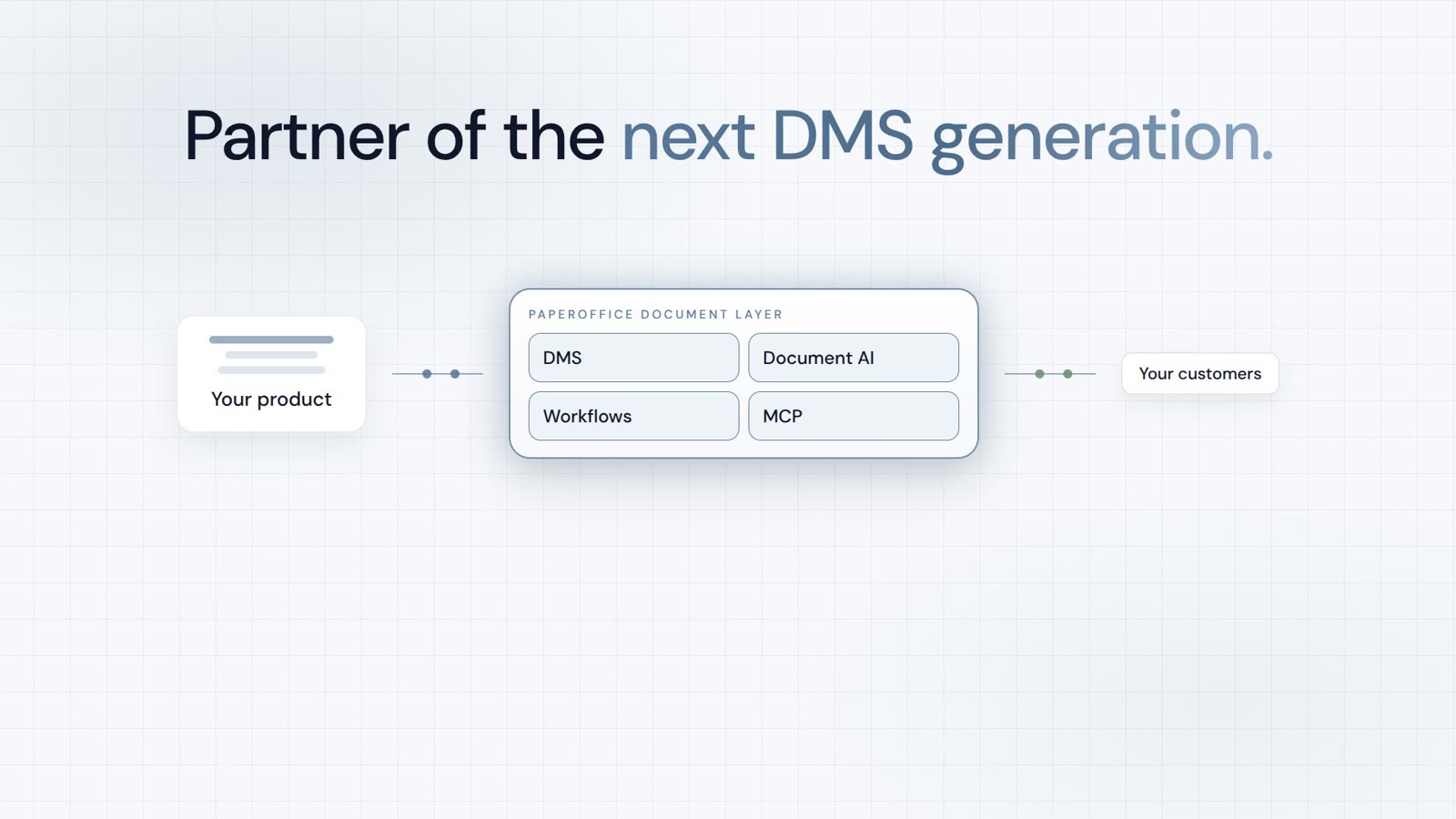
Integrator and Reseller can be combined. Referral by invitation.
View the partner program
AI-DMS
Documents. Intelligence. Real impact.
PaperOffice AI is the AI-DMS. Four functional areas on one DMS foundation, with three ways in.
Features, modules and benefits at a glance.
Capture, organize, search and collaborate on documents.
Plug into your systems and AI workflows.