

Scan, Sign & AI Chat
Mobile App
The mobile app pairs with your account via QR code and brings scanner, signature, chat and documents to your phone.


Free tool
Turn photos and scanned pages into a PDF. JPG, PNG, WebP and iPhone photos (HEIC) – you decide the order, page size and margin.
Save photos and images as PDF, several images in one file.
Your files are processed directly in your browser and are not uploaded. They never leave your device.
How it works
Drop photos or scans into the box or choose them. JPG, PNG, WebP, GIF and HEIC are supported.
Arrange the images by drag and drop or with the arrows. Choose page size, orientation and margin.
Click "Convert to PDF" and download the PDF – or one PDF per image in a ZIP file.
The conversion runs entirely in your browser. Your photos are not sent to a server. That matters especially for ID cards, receipts or contracts.
With A4 and US Letter, every image is fitted to the page and centered. With "Automatic", landscape images get a landscape page. With "Same as image", each page is exactly as large as the image; the resolution is taken from the image, otherwise the tool assumes 150 dpi. A small margin is 10 mm wide, a large margin 25 mm.
More with PaperOffice AI
AI-OCR in the AI-DMS reads scans, photos and PDFs in more than 120 languages and returns text, tables and positions per line – in the app, via API and via MCP.
FAQ
No. The conversion runs entirely in your browser. Your images never leave your device.
JPG, PNG, WebP, GIF and HEIC/HEIF, the iPhone photo format. For animated GIFs, the first frame is used. You can add up to 100 images of at most 50 MB each, up to 250 MB in total.
JPG files go into the PDF unchanged, without being compressed again. PNG stays lossless. WebP, GIF and HEIC are converted to JPG or PNG; images with transparency are stored as PNG.
Phones often store photos sideways and only note the rotation in the image data (EXIF). The tool reads that note and places the image upright in the PDF.
Yes. Under "Output", choose "One PDF per image". You then get all PDF files together in one ZIP file.
More tools
Free tools from PaperOffice AI for invoices, deadlines and documents.
Choose language
Select currency
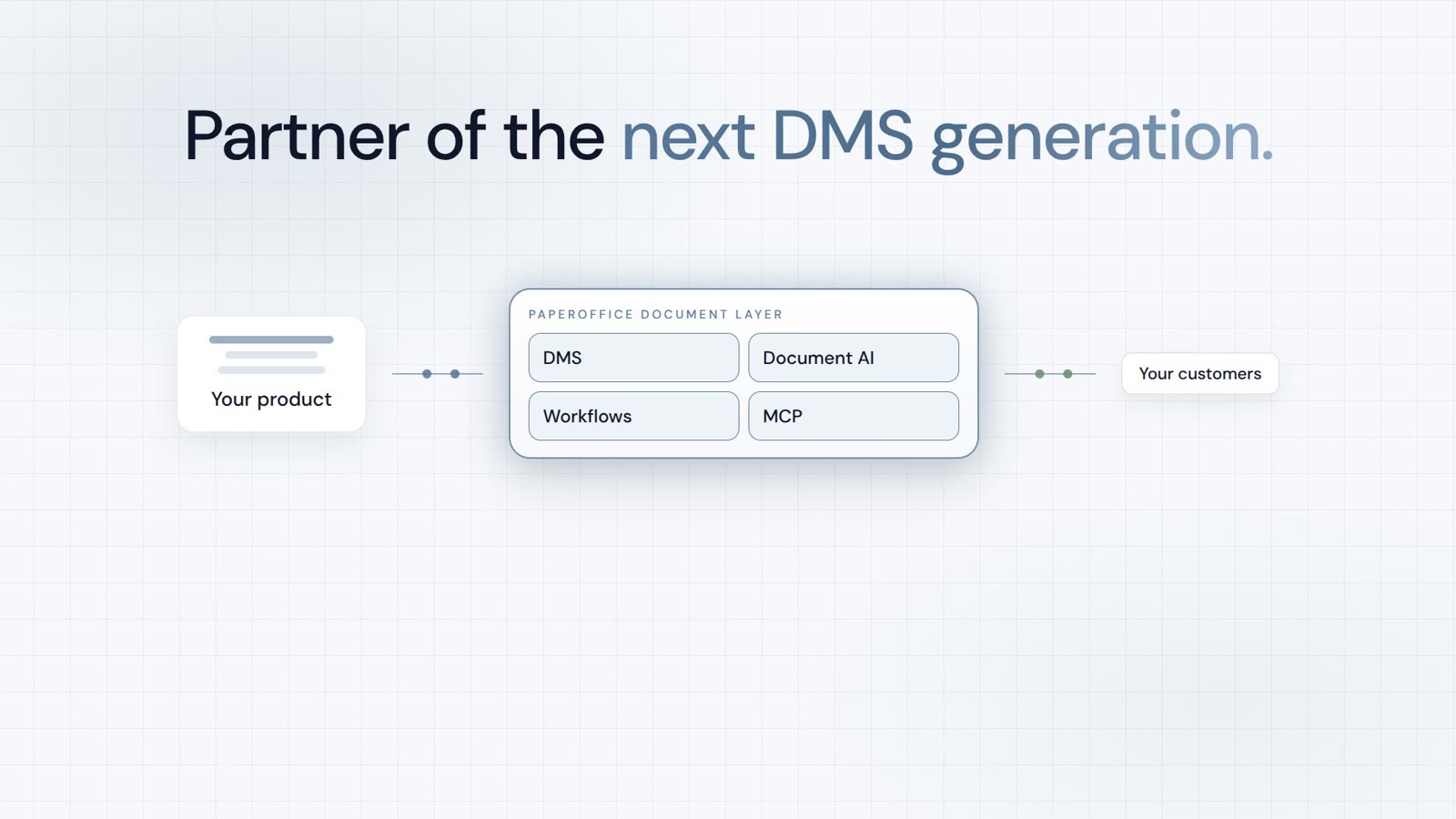
Integrator and Reseller can be combined. Referral by invitation.
View the partner program
AI-DMS
Documents. Intelligence. Real impact.
PaperOffice AI is the AI-DMS. Four functional areas on one DMS foundation, with three ways in.
Features, modules and benefits at a glance.
Capture, organize, search and collaborate on documents.
Plug into your systems and AI workflows.