Scan, Sign & AI Chat
Mobile App
The mobile app pairs with your account via QR code and brings scanner, signature, chat and documents to your phone.

An external auditor needs an employment contract, but not the person behind it. The Redact Agent replaces names, addresses and identifiers with consistent fictitious values: the document stays readable, and the original stays untouched.
Hi, and welcome back to the PaperOffice AI Academy. Today we’ll look at something every company runs into sooner or later: you need to share a document, but not the personal data inside it. Here’s our situation. Northstar’s payroll is audited by an external firm. The auditors need Maya’s employment contract, to check that her salary is handled correctly. What they don’t need is Maya herself: her name, her home address, her personal identifiers. This is the Northstar HR workspace, with the employment contract, the payslip, and an incident report.
Let’s open the contract first, so you can see what we’re dealing with. Here’s Maya’s full name. Her private address in London. And her annual salary. All of this is personal data, and it appears on all three pages. Removing it by hand is slow, and it’s easy to miss a spot. So let’s let PaperOffice do it.
Back in the list, I select the contract, open Agents and workflows, and choose Redact. I’ll take Edit with preview, so I can check everything before anything is saved. First, the scenario. What is the document for? There’s one for G D P R requests, one for sharing with business partners, and this one fits best: Personnel File, HR.
In fine-tuning, I can name things that should stay visible. The auditors should still see which company this is, just not which person. So: Northstar Industrial Systems, and the short form, Northstar. Under execution: the result is saved right here in this workspace. The model is Ultra, and instead of black boxes, I’ll pick Pseudonymize. Pseudonymize means: names, addresses, dates and identifiers are replaced with consistent, fictitious values. The document stays readable, and the auditors can work with it as if it were the real thing. And… start. This takes a few seconds, so let’s skip ahead. Here’s the review. PaperOffice found the personal data on all three pages and marked every area it will replace. I could click an area to release it, or draw a box to add one. Everything looks right, so I’ll apply it.
Done. And this table is the interesting part: on the left the original, on the right what’s in the document now. Maya Ellison is now a fictitious person, with a fictitious address and a new contract number. This table is only visible here. It’s never part of the P D F. It’s for you, so you know what you’re looking at when you talk about the document later. One more detail: every run creates new pseudonyms. So if you share two documents at different times, nobody can link them back together. From here I could download the copy, or send it by e-mail, straight to the auditors.
The pseudonymized copy now sits right next to the original. The original itself stays untouched. Let’s open the copy. Maya is now Sophie Foster, living in Glasgow. Where no safe replacement exists, like the country, PaperOffice simply blacks it out. And the salary is still there for the audit.
That’s it: personal data out, a readable document in, in about a minute. Thanks for watching, and see you in the next lesson.
Choose language
Select currency
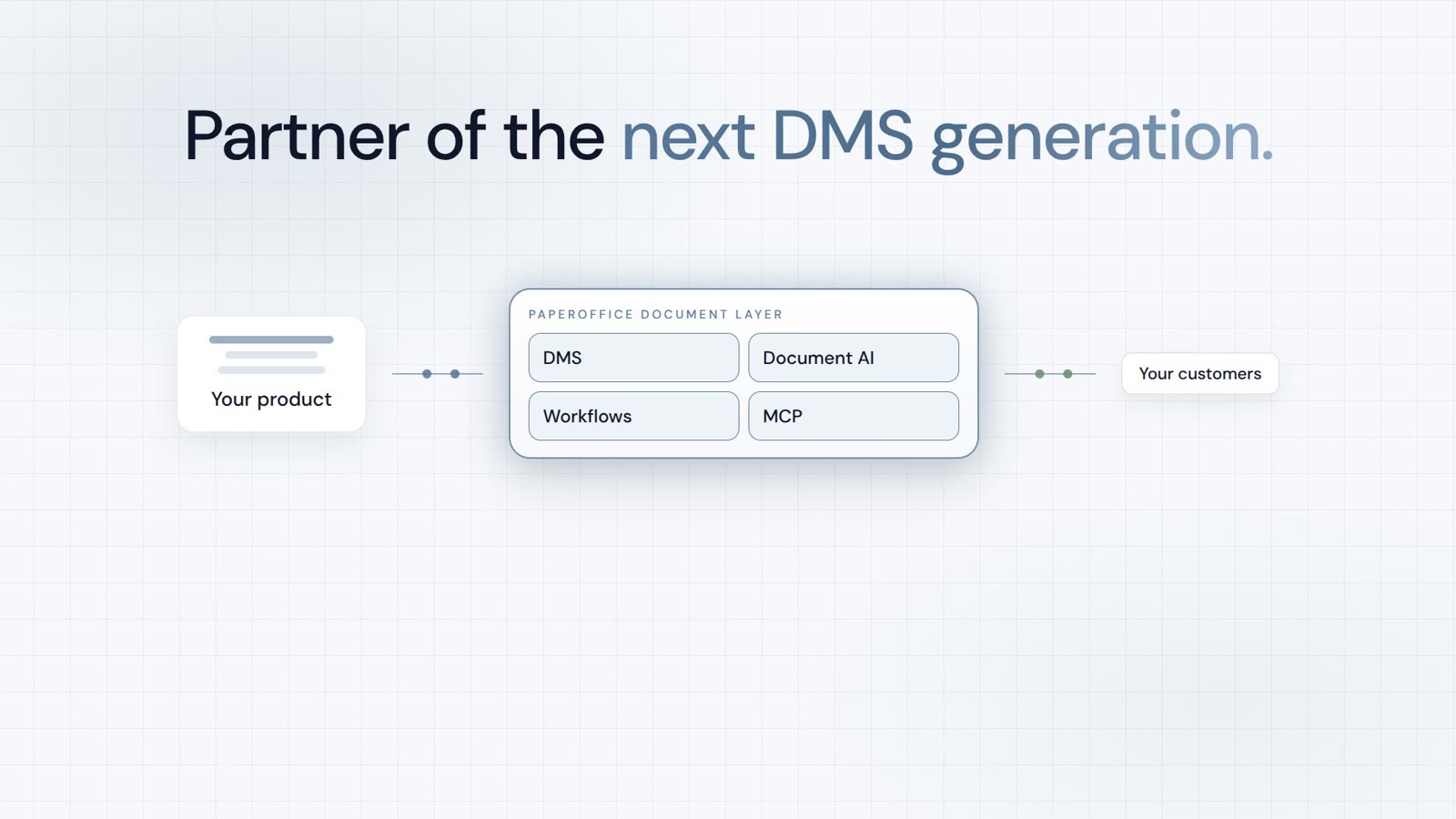
Integrator and Reseller can be combined. Referral by invitation.
View the partner program
AI-DMS
Documents. Intelligence. Real impact.
PaperOffice AI is the AI-DMS. Four functional areas on one DMS foundation, with three ways in.
Features, modules and benefits at a glance.
Capture, organize, search and collaborate on documents.
Plug into your systems and AI workflows.