












What Does API-First Mean — and Why Should Everyone Care?
API-first means every capability is designed first as a stable, versioned interface — before UI, plugins, or one-off integrations. For the document industry, this is a strategic shift: documents become data-ready assets that plug into ERP, CRM, ticketing, and automation.
The numbers are unambiguous: industry surveys show 82% of enterprises had adopted or prioritized an API-first approach by 2025 — not only in IT but across business functions. The global market for API management and related platforms is sized around $32.77B for the coming years. If you still think in terms of "file storage only," you underestimate how much competitiveness now depends on integration speed.
"API-first is not a technology label — it is the answer to how fast your organization can activate new partners, processes, and AI capabilities."
The Problem: Why Classic DMS Integrations Fail
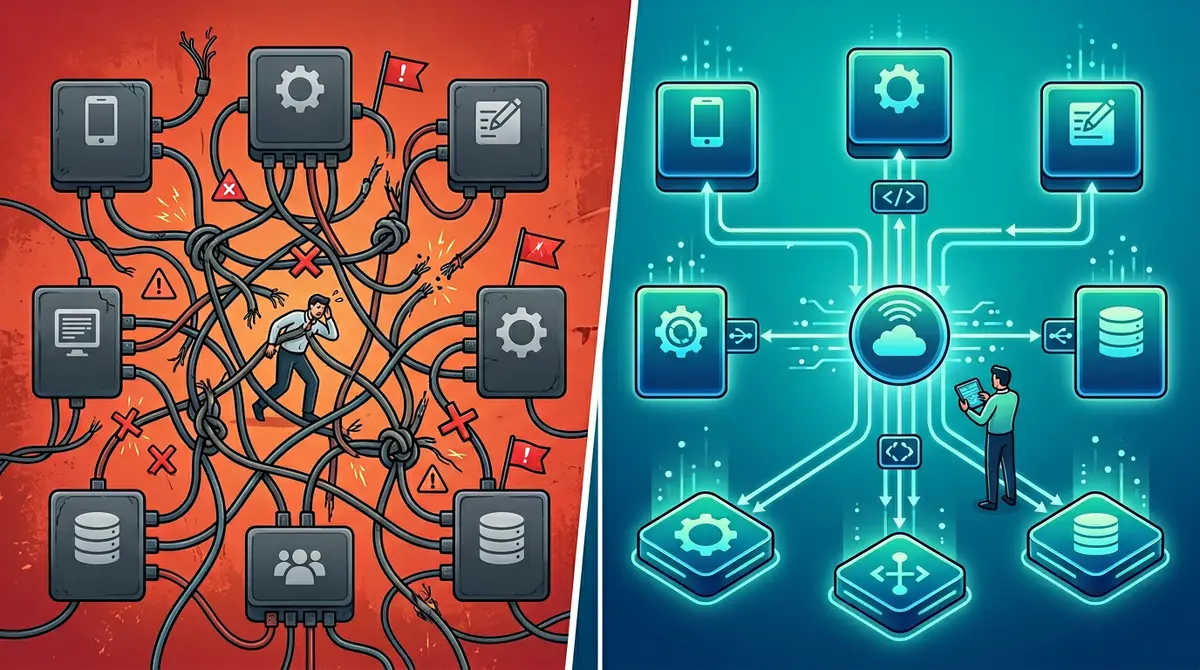
Traditional DMS products were often sold with plugin ecosystems and vendor-specific tooling: every connection is a project, every upgrade a risk. The outcome is plugin hell: long release cycles, brittle dependencies, and vendor lock-in that slows innovation.
Having "some REST endpoints" is not enough — without a product philosophy, the API remains an afterthought. API-first defines contracts first: consistent auth, consistent errors, consistent versioning.
| Criterion | Plugin-based | REST without API-first | API-first |
|---|---|---|---|
| Integration model | Installers, binaries, manual care | Ad-hoc endpoints, inconsistent schemas | Contract-first, OpenAPI/docs, stable versions |
| Time-to-integration | weeks to months | days to weeks | hours to days |
| Vendor lock-in | high | medium | low (consumer replaceability) |
| Scaling | often manual / instance-bound | partial | horizontal, automated, monitored |
| Fit for AI/orchestration | poor | medium | high (atomic tools, hooks) |
The Five Pillars of an API-First Platform
A mature API-first architecture rests on five pillars — all required to turn interfaces into a product:
- Atomic tools: each endpoint does exactly one job — composable in pipelines and agent workflows.
- Batch & bulk: high-volume processing without chatty traffic — for scans, invoice runs, migrations.
- Developer docs: first-class reference, examples, error codes — not a "PDF from 2019."
- Webhooks & events: push instead of poll — status changes, processing complete, compliance signals.
- MCP compatibility: connection to modern AI clients and tool routers — the API becomes part of the LLM ecosystem.
300+ Tools: How PaperOffice Unifies AI-First and API-First
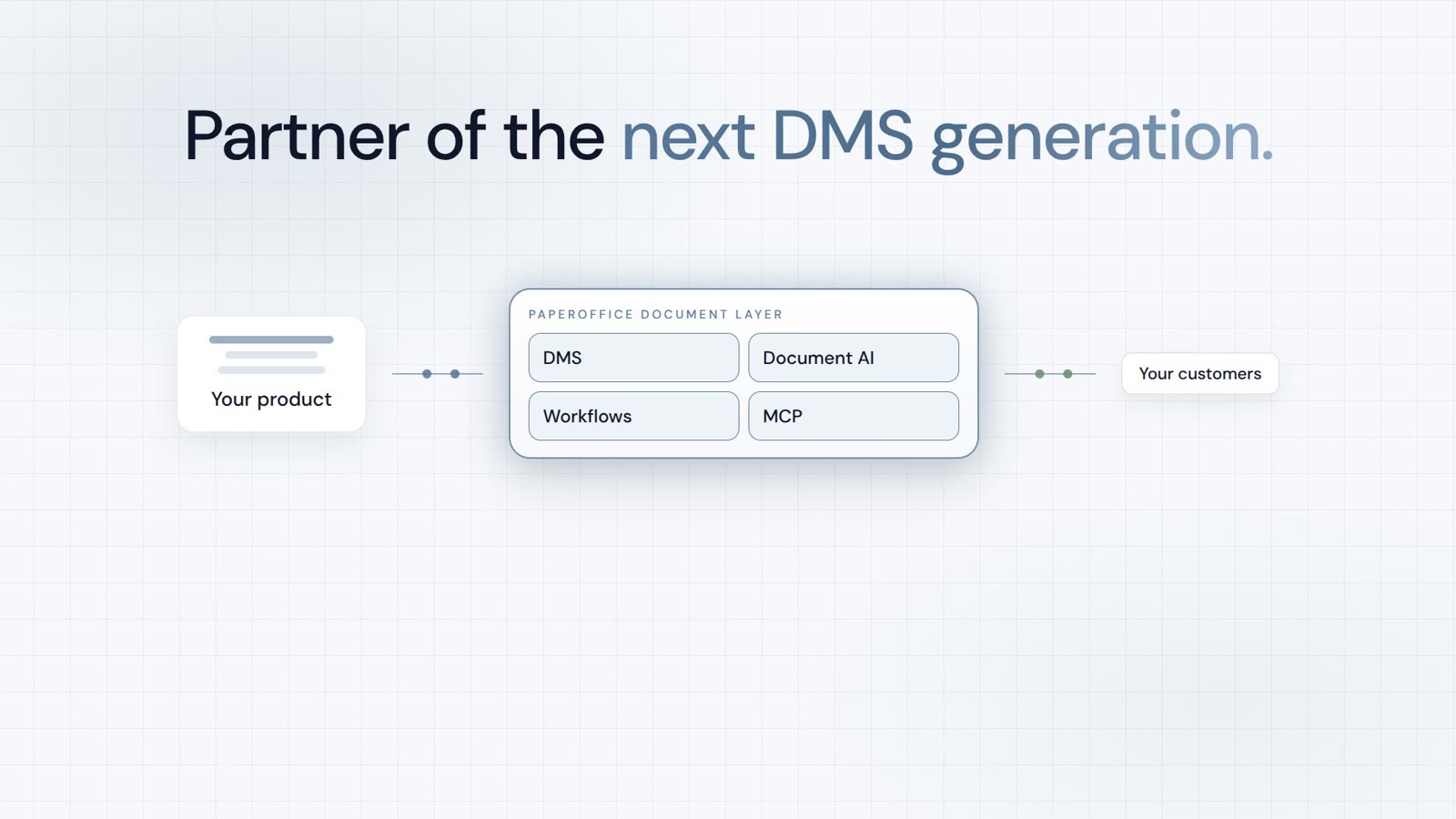
PaperOffice combines AI-first routing (LLM as router, intelligent orchestration) with API-first execution (atomic operations, clear contracts). Instead of monolithic "do everything" calls, there is a broad toolkit — 300+ tools grouped by domain.
| Category (excerpt) | Tools (approx.) | Example value |
|---|---|---|
| Intelligent Document Processing | 98 | extraction, classification, quality checks |
| OCR & layout | 76 | text recognition, tables, structure |
| Search & knowledge graph | 54 | semantic hits, entity linking |
| Integration & automation | 81 | connectors, triggers, handoffs |
| Security & compliance | 67 | PII, audit, access control |
| Verticals & special cases | 67 | finance, logistics, public sector |
| Total / dynamic growth | 300+ | API database as single source of truth |
This breadth is not a feature arms race — it is practical decoupling of business logic and infrastructure. Teams pick exactly the operations they need instead of configuring an overloaded monolith.

What API-First Means for Developers
For developers, the focus shifts from scraping internal portals to clean contracts and tests. Typical project effects:
- Time-to-first successful call: often < 1 day instead of multiple sprints
- Less glue code: defined payloads instead of CSV workarounds
- Better observability: per-endpoint metrics, tracing, budgets
Field data often shows 40–70% reduction in integration duration after API-first adoption — depending on legacy and team size. Repeatability matters as much as speed: the same call behaves in staging like in production.
API Security and Governance in the Enterprise
The more powerful the API, the stricter the guardrails. Enterprise-grade setups combine:
- Bearer tokens & short-lived credentials with rotation and least-privilege scopes
- Rate limiting & quotas — fairness across teams and abuse protection
- Zero-trust networking — no implicit trust, only evidence-based access
- Audit trails — who processed which document when — mandatory for audits and regulators
"Security is not an add-on: it becomes part of the API contract — from auth to provability."
Scale, SLAs, and Operations: API-First End-to-End
API-first does not end at the gateway. Product teams plan SLAs, queues for peak load, and idempotent operations so retries are safe. Observability (RED/USE metrics) and chaos testing for failure modes belong to maturity — especially when document pipelines are business-critical.
Conclusion: The API Is the New User Interface
The document industry is moving from "upload a file, search a folder" to connected, machine-executable processes. The API is not just plumbing — it is the new user interface for partners, automation, and AI. Organizations that implement API-first consistently gain speed, transparency, and independence from single vendors. PaperOffice delivers 300+ atomic tools combined with an AI-first architecture — ready for the next integration wave.


