













What Is Agentic AI?
Agentic AI refers to systems that do not merely answer prompts but pursue goals, plan steps, use tools, and adapt their approach — closer to a digital worker executing tasks end-to-end. Unlike simple chatbots or static classifiers, these agents combine perception, reasoning, and action in closed loops.
“Agentic AI shifts responsibility from fixed rules to goal-directed behavior: the system decides which action makes sense next.”
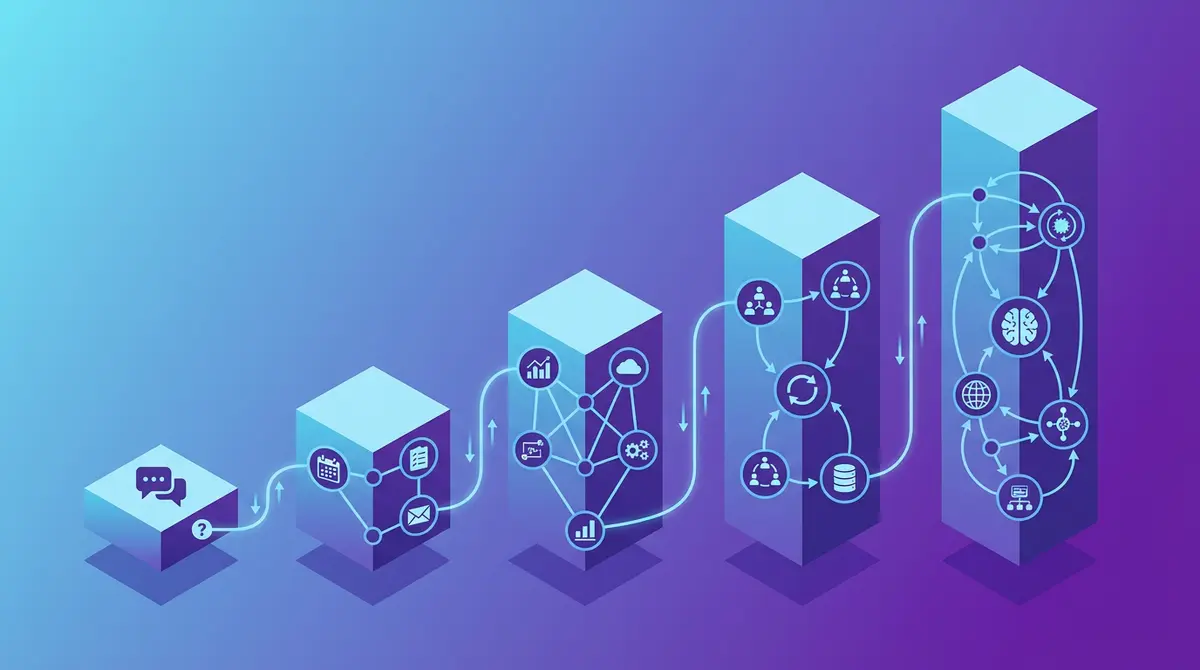
The Five Autonomy Levels (Gartner)
Gartner typically maps AI agent maturity from reactive assistance to autonomous, cooperating ecosystems:
- Level 1 — Assistance: AI suggests; humans execute.
- Level 2 — Partial automation: individual steps run automatically; escalation remains common.
- Level 3 — Goal-directed agents: the agent pursues a defined goal across multiple tools.
- Level 4 — Multi-agent: specialized agents coordinate (routing, review, enrichment).
- Level 5 — Autonomous ecosystem: agents operate across processes and systems with governance and monitoring.
For the document industry, the practical sweet spot is often levels 3 to 4: enough autonomy for throughput, with clear boundaries and human control.
Why 2026 Is the Year of Agentic AI
Market and CIO surveys show consolidation in 2026: about 40% of new or refreshed enterprise applications are expected to include AI agent capabilities (industry projection), organizations report 92% ROI in governed pilot clusters, and the global market for agentic AI is framed at over $183B for the coming years. Together with mature orchestration, better tool integration, and regulatory clarity, agentic AI moves from experiment to operating model.
Agentic AI in Document Processing
Classic AI-IDP pipelines are rigid; agentic AI replaces fixed rules with context-aware action. The comparison below summarizes typical differences:
| Dimension | Traditional | Agentic AI |
|---|---|---|
| Control | Fixed rules and templates | Goal-based planning and dynamic steps |
| Layout changes | New rules / retraining | Read and adapt without template churn |
| Exceptions | Manual inbox | Agent resolves or escalates precisely |
| System coupling | IF/THEN integrations | Tool calls (ERP, CRM, DMS) as needed |
| Traceability | Step logs | Audit trail including rationale steps |
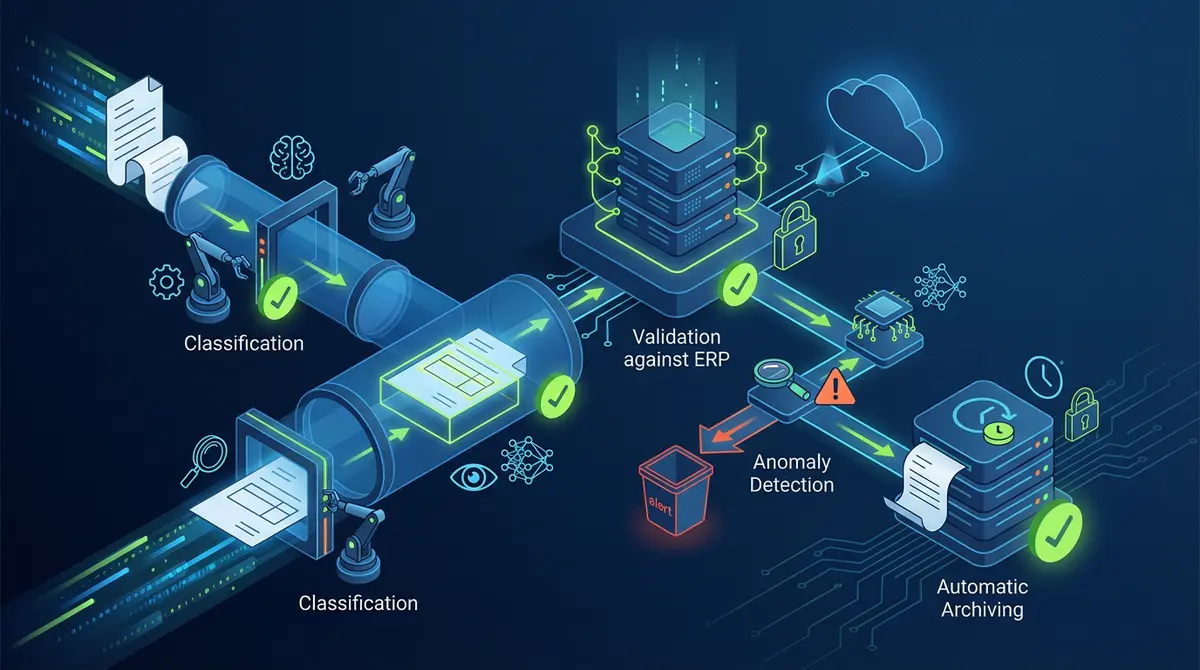 classification, extraction and automatic archiving" loading="lazy" />
How PaperOffice Implements Agentic AI
PaperOffice AI uses an agentic architecture for documents and knowledge:
- IDP Agents: understand document types in context and orchestrate extraction, validation, and handoff.
- 800+ LLMs: specialized model choice per task — balancing quality, cost, and latency.
- Knowledge Graph: links entities across documents and powers matching, fraud signals, and search.
This turns a pipeline into a cooperating system that adapts to new vendors, formats, and processes without a major IT project every time.
Real-World Example: Invoice Processing
A typical flow for an incoming invoice:
- Capture: agent detects layout, vendor, and references.
- Matching: PO/delivery checks via knowledge graph and ERP stubs.
- Plausibility: tax, currency, duplicates, approval rules.
- Posting proposal: accounts and dimensions prepared.
- Escalation: on variance, ticket to a specialist with rationale.
| Metric | Before (manual/rule-based) | After (agentic, governed) |
|---|---|---|
| Cycle time | 2—5 days | < 1 hour to same day |
| Touchless rate | 30—50% | 75—95% (complexity-dependent) |
| Exception handling | high manual share | targeted HITL slices |
| Template maintenance | high | significantly reduced |
Risks, Governance, and Compliance
Autonomy needs guardrails: human-in-the-loop (HITL) for edge cases, tamper-evident audit trails, roles and approvals, plus model and data governance. In the EU, the EU AI Act matters: risk-based duties, documentation, and monitoring apply to document-centric AI as well.
“Agentic AI only scales with trust: transparency, provability, and controlled escalation are prerequisites for production, not optional extras.”
Conclusion
Agentic AI changes the document industry fundamentally: from rigid pipelines to goal-directed, tool-using systems that fuse with enterprise knowledge and processes. 2026 is the year where technology, ROI evidence, and governance align — organizations that invest now in architecture, data quality, and policies gain both competitive advantage and compliance.


