













The Evolution of Document Processing
Document processing has come a long way — from manual data entry to OCR, from templates to Machine Learning. But the next leap is fundamentally different: Agentic AI-IDP replaces rigid pipelines with autonomous AI agents that think, decide, and act independently.
What is Agentic AI-IDP?
Agentic AI-IDP (Intelligent Document Processing) combines Large Language Models with an agent architecture. Instead of a fixed processing pipeline, autonomous AI agents analyze each document individually and decide dynamically how to handle it.
Traditional AI-IDP follows a recipe. Agentic AI-IDP is like an experienced employee who understands the document, knows the context, and makes the right decisions autonomously.

The 3 Generations of Document Processing
| Generation | Technology | Approach | Limitation |
|---|---|---|---|
| Gen 1 | OCR + Templates | Fixed zones per document type | Breaks with layout changes |
| Gen 2 | ML + NLP | Trained models per category | Months of training, limited flexibility |
| Gen 3 | Agentic AI-IDP | Autonomous AI agents with tools | Scales with complexity |
How Agentic AI-IDP Works
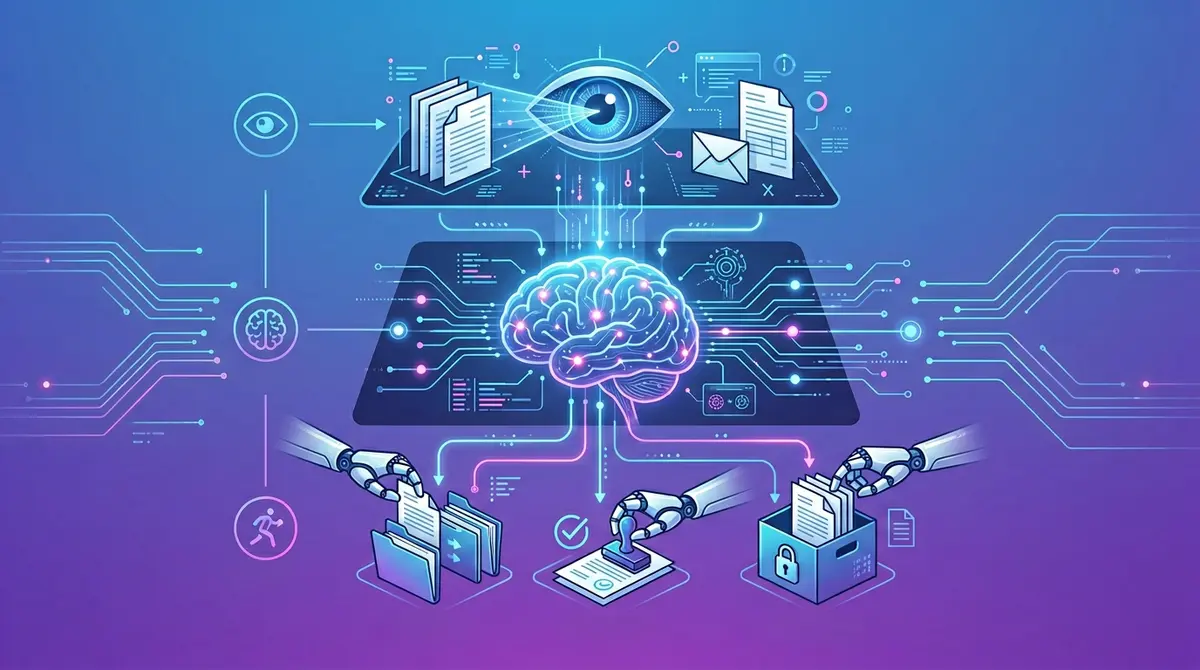
1. Perception — Understanding Instead of Scanning
The agent doesn't just extract text — it understands the document as a whole. Layout, context, relationships between data points, even handwritten notes are interpreted in context.
2. Reasoning — Thinking Instead of Matching
When an invoice references a contract, the agent finds that contract. When data is ambiguous, it cross-references other sources. When a field is missing, it knows where to look.
3. Action — Executing Instead of Suggesting
The agent doesn't just extract data — it routes documents, triggers workflows, sends notifications, and updates systems. All autonomously, all traceable.
Why Traditional AI-IDP Falls Short
Classic AI-IDP systems struggle with reality:
- Layout variance: Every supplier formats invoices differently
- Multi-document processes: A purchase order references a quote, delivery note, and invoice
- Exceptions: 20% of documents don't fit any template
- Context: The same field means different things in different documents
Agentic AI-IDP handles all of this natively — because agents reason about documents instead of pattern-matching them.
Real-World Impact
Companies using Agentic AI-IDP with PaperOffice report:
- 95%+ straight-through processing — even for documents never seen before
- 80% reduction in manual reviews — agents handle exceptions autonomously
- Zero template maintenance — no more updating extraction rules
- Minutes instead of days — from document receipt to processed data
The PaperOffice Approach
PaperOffice AI combines 800+ specialized LLMs with an agentic architecture:
- IDP Agents that understand any document type without training
- Workflow Agents that route, approve, and escalate autonomously
- Knowledge Agents that cross-reference your entire document corpus
- Human-in-the-Loop for edge cases — with learning from every decision
Conclusion: The Agent Era Has Begun
Agentic AI-IDP isn't an incremental improvement — it's a paradigm shift. Documents are no longer processed by rules but understood by intelligence. The question isn't whether to adopt Agentic AI-IDP, but how quickly you can get started.


